
No need to worry about scars as it is removed through the nostrils.
Who is the nasal implant removal suitable for?
- For those who do not like the shape of the implant.
- For those who are concerned about foreign substances.
An explanation of the nasal implant removal
If the implant is too high, the shape is not to your liking, the nose has become deformed or upturned, is red and swollen and infection is suspected, or the skin has become thin, it can be removed from inside the nasal cavity, cleaned, and restored to a clean state.
Features of our nasal implant removal
- The scar is only in the nasal cavity and is not noticeable.
- Hyaluronic acid injection can be performed at the same time as implant removal.
- Surgery is performed under intravenous anesthesia, without consciousness or pain.
Trouble Examples
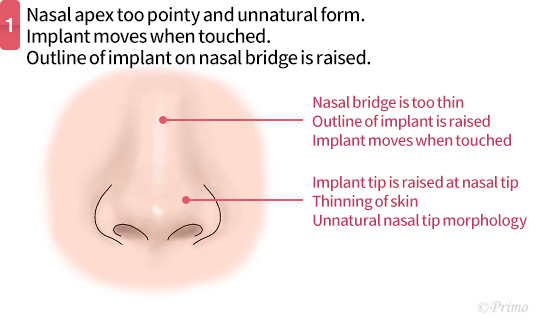
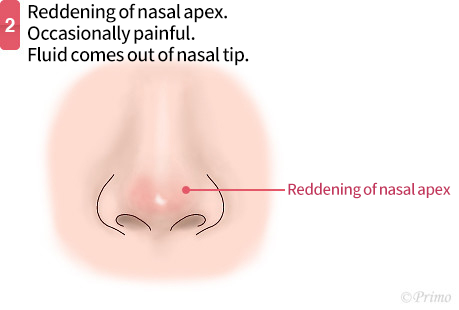
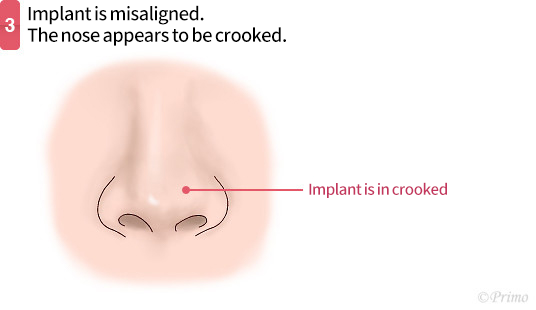
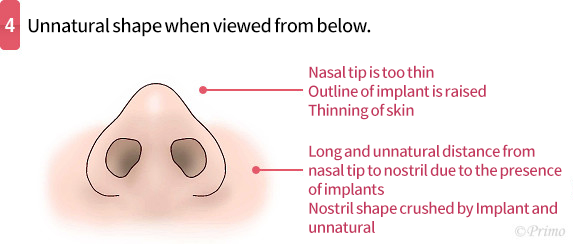
Example of removed implant
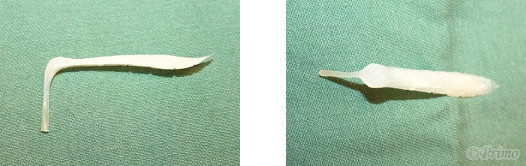
L-shaped implant with long legs.
The nasal tip was thin and unnaturally rounded, and the nasal tip was upturned, so it was removed.
It was more than 10 years old and some calcification was observed.
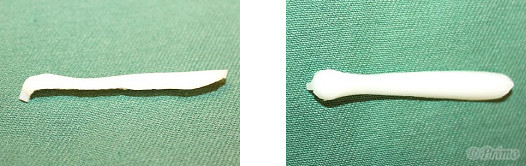
L-shaped implant with short legs.
The shape of the nasal tip was unnatural, so it was removed.
The nasal bridge was also a little too thin.
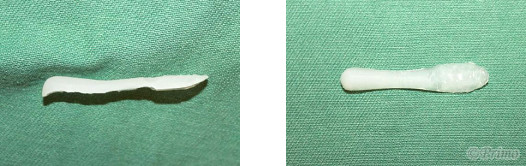
I-shaped implant.
It was in close to the nasal tip and the direction of the nasal tip was upward.
Even if it is an I-shaped rather than an L-shaped, if it is in all the way to the nasal tip, the skin may become thinner and the morphology of the nasal tip may be unnatural.
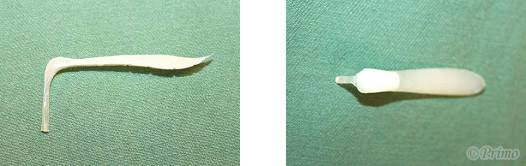
L-shaped implant with soft silicone at the bend.
This one was also slightly upturned and slightly bent in, so it was removed.
The nasal ala cartilage was also deformed due to the implant.
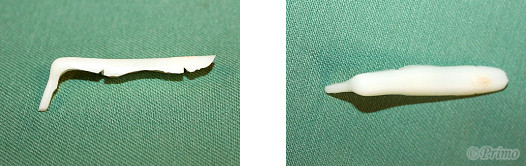
L-shaped implant.
It had been in place for about 10 years.
There was an unnatural area at the nasal tip due to the implant, which was slightly crooked, and the nose was upturned, so it was removed.
Some calcification was observed.
Surgery method
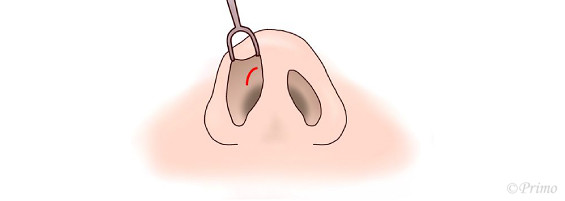
The previous incision is reopened in a small incision and the implant is removed from the nasal cavity.
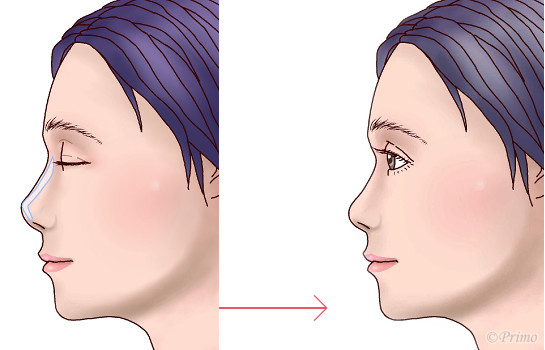
Remove the implant from inside the nose.
If the implants are too large or poorly positioned and the nose is deformed, it may be necessary to simultaneously correct the deformed nose with a cartilage graft (e.g., caudal septal extention graft surgery, tip rhinoplasty) or soft tissue graft (e.g., dermal fat graft, temporal fascia graft).
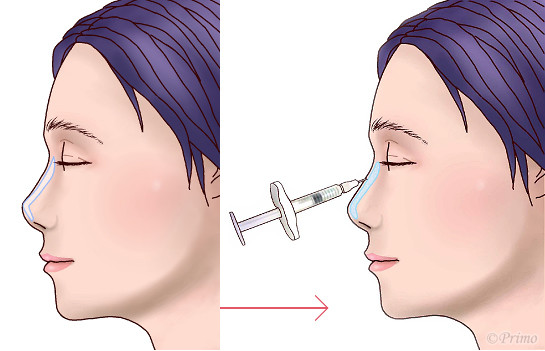
Hyaluronic acid or other injections can be performed at the same time as the implant removal to maintain the height and form of the nose.
In this case, the nose does not change significantly before and after the surgery, and the hyaluronic acid is slowly absorbed, bringing it closer to the original nose, so there is less risk of being discovered by others.
Videos of nasal implant removal
References and articles on nasal implant removal
Removal of Nasal Silicone Implant and the Impact of Subsequent Capsulectomy.
Kook WS, Yang CE, Lew DH.Plast Reconstr Surg. 2019 Oct;144(4):575e-585e. doi: 10.1097/PRS.0000000000006095.PMID: 31568287
Failure of Synthetic Implants: Strategies and Management.
Jang YJ, Kim SA, Alharethy S.Facial Plast Surg. 2018 Jun;34(3):245-254. doi: 10.1055/s-0038-1654676. Epub 2018 Jun 1.PMID: 29857334
Reply: Removal of Nasal Silicone Implant and the Impact of Subsequent Capsulectomy.
Kook WS, Yang CE, Lew DH.Plast Reconstr Surg. 2020 Jul;146(1):94e-95e. doi: 10.1097/PRS.0000000000006945.PMID: 32590672 No abstract available.
Surgical Nasal Implants: Indications and Risks.
Genther DJ, Papel ID.Facial Plast Surg. 2016 Oct;32(5):488-99. doi: 10.1055/s-0036-1592101. Epub 2016 Sep 28.PMID: 27680520 Review.
Duration, downtime and aftercare of nasal implant removal
《After surgery》
Condition of the affected area
The nasal cavity is sutured with blue thread.
Stitches are usually removed on the seventh day.
Nasal plug (cotton ball) is used on one side only.
Please remove it yourself after you return home on the same day.
The anesthesia may cause a sore throat.
Usually improves in a few days.
Post-operative checkup and aftercare
You will be examined by the doctor after surgery just before you go home.
Antibiotics, painkillers (the pain is usually mild, but we prescribe them just in case), and gastric medicine will be prescribed for 4 days after surgery.
Lifestyle advice
You can take a shower, wash your hair and face on the same day after surgery.
The pain is not so severe and can be adequately controlled with ordinary oral analgesics.
Nosebleeds or nasal discharge with blood may occur.
When doing so, do not blow your nose or stuff tissues, but wipe gently.
When sleeping, please use cushions to elevate your upper body.
Sleeping on your stomach or side is prohibited as it causes stress on the nose.
Please refrain from drinking alcohol and smoking for about a week.
《Days 7 after surgery》【Please book an appointment for stitches removal】
Condition of the affected area
Swelling will subside to some extent on the first to third day.
In rare cases, there may be swelling up to the eyes.
There may be bruising around the nose.
The bruising will usually disappear in 1-2 weeks.
Post-operative checkup and aftercare
There will be a medical checkup by a doctor.
Stitches will be removed from your nasal cavity.
Lifestyle advice
From the 7th day after surgery, you can bathe as usual.
Please do not touch your nose, clean your nose, or blow your nose for one month after the surgery.
《2 weeks after surgery》【Please book an appointment for a checkup as needed】
Condition of the affected area
Swelling and internal bleeding will settle down considerably.
Post-operative checkup and aftercare
You will be examined by a doctor.
There is no post-operative medical procedure.
Lifestyle advice
Please do not touch your nose, clean your nose, or blow your nose for one month after the surgery.
《1 – 3 months after surgery》【Please book an appointment for a checkup as needed】
Condition of the affected area
The nose will gradually return to its natural state, but there will still be edema and swelling.
Post-operative checkup and aftercare
You will be examined by a doctor.
There is no post-operative medical procedure.
Lifestyle advice
You can resume all of your daily activities.
《6 months after surgery》【It is recommended that you visit for a checkup】
Condition of the affected area
The swelling goes down and the nose returns to its natural state.
Post-operative checkup and aftercare
You will be examined by a doctor.
There is no post-operative medical procedure.
Lifestyle advice
You can resume all of your daily activities.
FAQ
Answers to questions about nasal implant removal.
Click on each question to see the answer.
It settles down in about a week after surgery.
Make-up can be applied immediately after surgery.
L-shaped implants tend to deform the cartilage of the nasal apex and thin the skin of the nasal apex, which may be deformed in the worst case scenario.
Because the implant is a foreign body, a capsule forms around it.
Long-term use of implants can lead to calcification.
Some unevenness may remain depending on the capsule.
For the remaining deformity, aggressive surgical methods to improve the nasal morphology further include caudal septal extension graft.
Simultaneous injections of hyaluronic acid are also effective in improving small deformities.
If you are unhappy with the shape, too high or too low, the implant moves when touched, or is crooked, or if you are dissatisfied with previous rhinoplasty, the implant can be replaced for improvement.
Surgery is performed from inside the nose.
Shapes are custom-made and processed according to your requests.
If the implant moves, it can be reinserted under the periosteum of the nasal bone to prevent it from moving.
If it is bent, it can be straightened by tight pull-out fixation.
Our nasal surgery is basically performed under intravenous anesthesia, so you will not feel any pain.
If surgery under local anesthesia is desired, block anesthesia is used in combination with anesthesia to minimize the pain of administering anesthesia.
Fees
| Nasal Implant Removal | After surgery at our clinic | ¥110,000 |
|---|---|---|
| After surgery at another clinic | ¥165,000 |
All fees displayed include tax.
Normal post-operative symptoms, downtime, risks and complications
Underneath is a list of things that may occur.
In order to prevent any of these symptoms from occurring, we take safety measures and perform treatment with the utmost care.
We will always improve your symptoms.
Normal post-operative symptoms and downtime
Swelling
Swelling will go down in 1 – 3 days after surgery.
Bruising around the nose
There may be bruising around the nose.
It sometimes occurs, but it will disappear in a week or two.
Discomfort after surgery
Dull pain and discomfort may occur after surgery.
It often disappears within a few days.
When combined with hyaluronic acid injections
After hyaluronic acid injection, the nose is soft and the hyaluronic acid moves when touched.
Please be careful not to touch it.
Dull sensation at the tip of the nose
Postoperatively, there may be a dulling of sensation at the tip of the nose, but this is often temporary.
It will improve over time.
Nosebleed
Nasal bleeding may occur after surgery.
Do not put fingers or other objects in the nostrils.
Risks and complications
Change in nose height after surgery
It will be lower due to removal of implants.
The nasal bones may be deformed.
If peri-implant capsule is calcified, it may remain hard.
Infection
Although rare, there is a risk of infection with any surgery.
If infection occurs, it may be necessary to treat it with intravenous antibiotics, cleaning procedures, and in some cases removal of foreign bodies.
Deformation of nasal tip after surgery
If implant is placed all the way to nasal tip, the cartilage at the nasal tip may be deformed.
Skin may be thinned and stretched, and nasal tip may be deformed.
If deformed, cartilage grafting, such as caudal septal extension graft, or temporal fascia grafting may be necessary.
Hyaluronic acid remains
When hyaluronic acid is injected, in rare cases it is not absorbed and may remain.
If this is a concern, it can be addressed with hyaluronic acid degradation injections.
Rhinoplasty list
Detailed information on each rhinoplasty procedure, including case photos, case progress photos, procedure duration, post-operative course, downtime, aftercare, risks and complications.
Supervising Doctor
Under the supervision of our plastic surgeons, we operate our website in accordance with medical advertising guidelines.
NORIHIRO OHBA M.D. Ph.D.
HEAD DIRECTOR/DIRECTOR
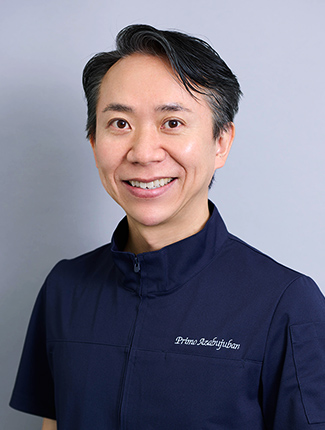
Qualifications and Academic Affiliations
Doctor of Medicine
Board Certified Plastic Surgeon, Japan Society of Plastic and Reconstructive Surgery
Board Certified Aesthetic Plastic Surgeon, Japanese Society of Aesthetic Plastic Surgery
Board Certified Aesthetic Plastic Surgeon, Japanese Society of Aesthetic Surgery
Anesthesiologist certified by the Ministry of Health, Labor and Welfare
Member of International Society of Aesthetic Plastic Surgery (ISAPS)
International Member of American Society of Plastic Surgeons (ASPS)
Member of Japan Society of Cranio-Maxillo Facial Surgery
Member of Japan Society of Laser Surgery and Medicine
Career
Graduated from Osaka City University Faculty of Medicine, 1996
Osaka City University Hospital Plastic and Reconstructive Surgery, 1996-1999
Osaka City University Graduate School of Medicine, 1999-2003
Osaka City University Hospital Plastic and Reconstructive Surgery, 2003-2005
Sano Memorial Hospital Plastic and Reconstructive Surgery, 2003-2005
Daito Central Hospital Plastic and Reconstructive Surgery, 2003-2005
Ritz Cosmetic Surgery Tokyo Clinic, 2005-2008
Primo Azabujuban Clinic, 2009~
Head Director, Primo Medical Corporation, 2011~
Head Director/Director, Primo Azabujuban Clinic, 2020~
