
Thinning and toning thick nasal bridge
Straighten the crooked nasal bridge
This is a procedure to make a large nose smaller, to thin a thick nasal bridge, to straighten a humped nose, or to straighten a crooked nasal bridge, etc., by means of nasal bone plastic surgery such as nasal bone osteotomy narrowing and osteotomy of the hump area to achieve the desired nasal line.
Nasal bone plasty is performed from an open approach with a secure field of view, but surgery can also be performed from a closed approach if desired.
The nasal septum cartilage is also processed at the same time if necessary.
After surgery, external immobilization with a thermoplastic cast and internal immobilization with a surgical sponge are performed for one week.
Who is the lateral osteotomy (nasal bone narrowing) suitable for?
- For those who have a large nose and want to make it smaller.
- For those who have a prominent protruding nose bone and wish to have it straightened and flattened.
- For those who have a crooked nasal bridge and want to straighten it.
- For those who have a thick nasal bridge and want to make it thinner.
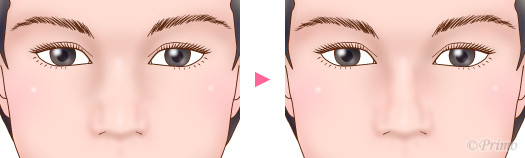
When the size and width of the upper half of the nose is large, lateral osteotomy (nasal bone narrowing) can be used to create a smaller, thinner nasal bridge.
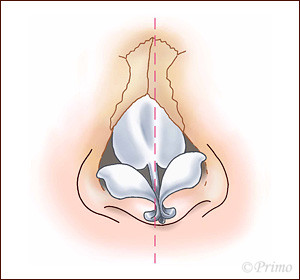
This is a surgery to adjust a crooked nose.
The nose may appear crooked because of a crooked nasal bone, a crooked nasal septum cartilage, or both.
Features of our Lateral Osteotomy (Nasal Bone Narrowing)
- Basically, an open approach is used.
- It is suitable for correction of crooked nose deformity, etc.
- Surgery is performed under general anesthesia to ensure a safe airway.
- CT imaging is available in our clinic. This allows for rapid diagnosis and is useful for post-operative follow-up.
Surgery method
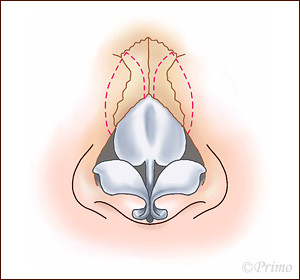
If the nasal bones are crooked, a nasal osteotomy is performed.
Straighten tilted nasal bones by osteotomies medially and laterally to center.
It may be done with an open approach, a nasal cavity approach only, or a combined approach from the skin side.
After the surgery, the patient will be immobilized in a cast for about one week.
If the nasal septum cartilage is crooked, it is corrected.
The crooked area is removed and the lateral nasal cartilage attachment of the nasal septum is removed and reattached to straighten it.
Revision of Lateral Osteotomy (Nasal Bone Narrowing)
- For those who have undergone lateral osteotomy at another clinic to correct a crooked nose but still have a crooked nose.
- For those who have undergone lateral osteotomy to create a thinner nose but would like to make it thinner.
In cases where a patient has undergone surgery to straighten a crooked nose at another clinic but is still concerned about the crookedness, nasal osteotomy is performed again to correct the crookedness.
In some cases, crooked nose correction may also be necessary.
It can also be made thinner and higher by combining it with augmentation rhinoplasty.
Osteotomy is performed to correct a patient who has undergone a nasal osteotomy but still has a large or thick nose.
Rhinoplasty is also used to correct a hump that has been cut off but still protrudes, a nose that feels thicker because of the cutting, or a flattening of the nasal bridge.
If a patient has undergone surgery to correct a deflected nose but still has a crooked nasal bridge, it can be corrected again through lateral osteotomy.
References and articles on Lateral Osteotomy (Nasal Bone Narrowing)
Broad nasal bone reduction: an algorithm for osteotomies.
Gruber R, Chang TN, Kahn D, Sullivan P.Plast Reconstr Surg. 2007 Mar;119(3):1044-53. doi: 10.1097/01.prs.0000252504.65746.18.PMID: 17312512
Curved lateral osteotomy for airway protection in rhinoplasty.
Webster RC, Davidson TM, Smith RC.Arch Otolaryngol. 1977 Aug;103(8):454-8. doi: 10.1001/archotol.1977.00780250048003.PMID: 880115
Component dorsal hump reduction: the importance of maintaining dorsal aesthetic lines in rhinoplasty.
Rohrich RJ, Muzaffar AR, Janis JE.Plast Reconstr Surg. 2004 Oct;114(5):1298-308; discussion 1309-12. doi: 10.1097/01.prs.0000135861.45986.cf.PMID: 15457053
Rhinoplasty: personal evolution and milestones.
Sheen JH.Plast Reconstr Surg. 2000 Apr;105(5):1820-52; discussion 1853. doi: 10.1097/00006534-200004050-00033.PMID: 10809116
Videos of Lateral Osteotomy (Nasal Bone Narrowing)
Duration, downtime and aftercare of Lateral Osteotomy (Nasal Bone Narrowing)
《After surgery》
Condition of the affected area
The entire nose is immobilized in a cast to reshape the nose and prevent swelling and internal bleeding.
It is usually immobilized for 7 days and is carefully removed during the procedure; do not remove it yourself.
If they are removed, the risk of prolonged swelling, nasal tip reshaping, or curvature goes up a bit.
We may insert a tube to drain blood that has accumulated in the nasal cavity.
It is important to minimize swelling and internal bleeding by draining accumulated and unwanted blood and tissue fluid.
Please do not pull it out or remove it by yourself.
It is usually removed on the second or third post-operative day.
Retainer is suture-fixed to the nostril.
Retainer should be used at home and other places as needed for 3 months after removal of fixation.
The nasal cavity is also sutured with blue thread.
Stitches are usually removed on the seventh day.
The surgery is performed through an open approach, resulting in a wound in the nasal cavity and columella.
The wound will be protected by a retainer or cast, so it will not be visible or touched from the outside.
The anesthesia may cause a sore throat.
Usually improves in a few days.
Post-operative checkup and aftercare
You will be examined by the doctor after surgery just before you go home.
We will replace it with a new drain tube just before you return home.
And check the condition of the cast and retainer.
Antibiotics, painkillers (the pain is usually mild, but we prescribe them just in case), and gastric medicine will be prescribed for 4 days after surgery.
Lifestyle advice
Please be careful not to get your face wet until the cast is removed.
You can shower only from the neck down, or from the chest down if a drain is attached.
Please refrain from bathing for a week.
The face should be wiped only.
Please refrain from washing your hair while the cast is attached.
If it is possible to protect the cast from getting wet, such as at a beauty salon, it is possible to wash hair.
The pain is not so severe and can be adequately controlled with ordinary oral analgesics.
Nosebleeds or nasal discharge with blood may occur.
When doing so, do not blow your nose or stuff tissues, but wipe gently.
When sleeping, please use cushions to elevate your upper body.
Sleeping on your stomach or side is prohibited as it causes stress on the nose.
After surgery, nasal congestion may occur due to swelling.
The original nasal septum cartilage is often not symmetrical and slightly tilted, so one side of the nose is more easily congested than the other.
Please refrain from drinking alcohol and smoking for about a week.
《Days 1-3 after surgery》【Please book an appointment for intravenous infusion】
Condition of the affected area
The nose wound is in a cast and retainer.
This is the peak time for swelling.
It often swells up to the eyes.
The swelling will subside to some extent in 7 to 10 days after surgery.
Swelling and internal bleeding may also occur on the cheeks.
Post-operative checkup and aftercare
We will check the condition of the drain the day after surgery and, if necessary, after the second day.
The drain will be removed when the amount of drainage is reduced.
Intravenous antibiotics will be administered the day after surgery and on the second day.
We will check the cast, retainer, and the condition of the wound.
Continue to take the oral medication prescribed after surgery.
Please inform us if you have any symptoms that may lead you to suspect side effects.
Lifestyle advice
You may shower only from the neck down, but please refrain from bathing for a week.
Please be careful not to get the cast wet when showering.
Nosebleeds or nasal discharge with blood may occur.
When doing so, do not blow your nose or stuff tissues, but wipe gently.
Please refrain from blowing your nose for a month after the surgery.
Please refrain from sleeping on your stomach or side and from pressing down hard on your nose for the 3 months after surgery.
《Days 7 after surgery》【Please book an appointment for cast removal and stitches removal】
Condition of the affected area
This is the period when the post-operative swelling causes the nasal bridge to look thicker, the tip of the nose to look rounded, and other unnatural features.
With time, the swelling will surely decrease and improve.
There may be bruising around the nose.
The bruising will usually disappear in 1-2 weeks.
Temporary sensory loss may occur at the tip of the nose and other areas.
It will improve over time.
Post-operative checkup and aftercare
There will be a medical checkup by a doctor.
Remove the cast/nostril retainer protecting the nose.
Stitches are removed from the columella and nasal cavity.
Lifestyle advice
From the 5th day after surgery, you will be able to wash your hair and face as usual.
Nose cleaning, sniffing, etc. should not be done for a month after the surgery.
Please refrain from touching your nose and sleeping on your stomach or side for 3 months after surgery, as it puts stress on the nose.
Post-operative rest is required.
Please refrain from strenuous exercise for 1-2 months.
Wear the nasal retainer at bedtime and while at home.
Make-up can be applied to the wound from the next day (8th day after surgery).
If you are concerned about the redness of scars on the columella, please consult us for medical concealer.
Do not force the scab off.
Please wipe off nosebleeds and runny nose by pressing down lightly, and do not use cotton swabs.
Please refrain from blowing your nose for a month after the surgery.
《2 weeks after surgery》【It is recommended that you visit for a checkup】
Condition of the affected area
Swelling and internal bleeding will settle down considerably.
Redness of the scar is a normal process.
Post-operative checkup and aftercare
You will be examined by a doctor.
There is no post-operative medical procedure.
Lifestyle advice
Nose sniffing, etc. should not be done for a month after the surgery.
Please refrain from touching your nose and sleeping on your stomach or side for 3 months after surgery, as it puts stress on the nose.
Wear the nasal retainer at bedtime and while at home.
《1 – 3 months after surgery》【It is recommended that you visit for a checkup】
Condition of the affected area
The wound will gradually heal completely, but there will be some swelling for a while.
Swelling between your eyebrows may be slightly bothersome, but will gradually subside.
Post-operative checkup and aftercare
You will be examined by a doctor.
There is no post-operative medical procedure.
Lifestyle advice
After a month post-operatively, you can blow your nose and clean your nose as usual.
Please refrain from touching your nose and sleeping on your stomach or side for 3 months after surgery, as it puts stress on the nose.
Wear the nasal retainer at bedtime and while at home.
《6 months after surgery》【It is recommended that you visit for a checkup】
Condition of the affected area
The wound has almost fully healed.
Your nose will gradually become softer and softer.
Nasal congestion will also improve.
Post-operative checkup and aftercare
You will be examined by a doctor.
There is no post-operative medical procedure.
Lifestyle advice
You can resume all of your daily activities, but just to be safe, protect the nose from bumping or crushing.
Nostril retainer attachment is no longer required.
FAQ
Answers to questions about lateral osteotomy (nasal bone narrowing).
Click on each question to see the answer.
It settles down in about two week after surgery.
After nasal apex surgery, you are usually immobilized in a cast for 7 to 10 days.
Make-up may be applied after cast removal.
After a nasal osteotomy, the bone will move for a while, during which time it is immobilized in a cast to fix it in a good position.
Once settled after surgery, the bone will not move or shift.
Surgery is basically performed under general anesthesia, so you will not feel any pain.
The procedure is a detailed, requiring 2-4 hours of operating time.
To ensure that the airway is secured during the procedure and that the surgery is performed safely, general anesthesia is used.
The surgery is not a very painful procedure, and the anesthesia concentration is maintained at a low level, so you can go home after resting in the recovery room for 2-3 hours after the surgery.
Lateral Osteotomy (Nasal Bone Narrowing) is performed almost exclusively from within the nose, with a partial incision in the nasal bridge to expand the surgical field.
Scars on columella are not visible from the front, and scars heal less noticeably.
Fees
| Lateral Osteotomy (Nasal Bone Narrowing) | ¥660,000 |
All fees displayed include tax.
Normal post-operative symptoms, downtime, risks and complications
Underneath is a list of things that may occur.
In order to prevent any of these symptoms from occurring, we take safety measures and perform treatment with the utmost care.
We will always improve your symptoms.
Normal post-operative symptoms and downtime
Swelling
Swelling will go down in 7 – 14 days after surgery.
Things will completely settle down in about 6 months.
Bruising around the nose
There may be bruising around the nose.
It sometimes occurs, but it will disappear in a week or two.
Discomfort after surgery
Dull pain and discomfort may occur after surgery.
It often disappears within a few days.
Nosebleed
Nasal bleeding may occur after surgery.
Do not put fingers or other objects in the nostrils.
Dull sensation at the tip of the nose
Postoperatively, there may be a dulling of sensation at the tip of the nose, but this is often temporary.
It will improve over time.
Scar
The surgery is performed through an open approach, which leaves a scar on columella.
Osteotomy may be performed through a small incision in the cheek.
There is redness of the scar for a few months, followed by a light brown to white scar over time.
Over a period of 3-6 months, the scars become less noticeable.
Risks and complications
Nasal tilt, insufficient correction of crookedness
Post-operative nasal tilt may occur.
Frequent touching of the nose or adding stress increases the risk.
After the swelling goes down, we will evaluate the shape and if necessary, revision surgery will be performed to correct.
Nasal congestion
Nasal congestion occurs after surgery.
If there is no improvement after 6 months of waiting, surgery may be required.
Irregularity of the nose
Some irregularities may occur in the nose after surgery.
If it is noticeable, it can be corrected with revision surgery.
Infection
Although rare, there is a risk of infection with any surgery.
If infection occurs, it may be necessary to treat it with intravenous antibiotics, cleaning procedures, and in some cases removal of foreign bodies.
Scar
The scar may be red and raised.
The wound is treated with creams, injections, and oral medications that improve wound healing.
If necessary, resection and re-stitching will be used to improve the situation.
In rare cases, a bump may remain.
Nasal bridge is too thick, not sure of the effect of the surgery
Due to swelling and other factors, the nose may not look as thin as expected after surgery.
Usually it gradually thins over the course of 3 to 6 months.
An injection procedure may be used to bring down the swelling as soon as possible.
Because there is a limit to the extent to which the nose can be thinned, there are rare cases in which the effect is insufficient.
Nose is too thin
Excessive touch or pressure during the postoperative process may cause the nose to be thinner than desired.
If it is too thin, it may be improved with another revision surgery.
Nasal bumps
If you touch the nose after surgery, you may feel a bump on the osteotomized area.
After 3-6 months of postoperative follow-up, improvement may be achieved with injections or revision surgery if necessary.
Rhinoplasty list
Detailed information on each rhinoplasty procedure, including case photos, case progress photos, procedure duration, post-operative course, downtime, aftercare, risks and complications.
Supervising Doctor
Under the supervision of our plastic surgeons, we operate our website in accordance with medical advertising guidelines.
NORIHIRO OHBA M.D. Ph.D.
HEAD DIRECTOR/DIRECTOR
Qualifications and Academic Affiliations
Doctor of Medicine
Board Certified Plastic Surgeon, Japan Society of Plastic and Reconstructive Surgery
Board Certified Aesthetic Plastic Surgeon, Japanese Society of Aesthetic Plastic Surgery
Board Certified Aesthetic Plastic Surgeon, Japanese Society of Aesthetic Surgery
Anesthesiologist certified by the Ministry of Health, Labor and Welfare
Member of International Society of Aesthetic Plastic Surgery (ISAPS)
International Member of American Society of Plastic Surgeons (ASPS)
Member of Japan Society of Cranio-Maxillo Facial Surgery
Member of Japan Society of Laser Surgery and Medicine
Career
Graduated from Osaka City University Faculty of Medicine, 1996
Osaka City University Hospital Plastic and Reconstructive Surgery, 1996-1999
Osaka City University Graduate School of Medicine, 1999-2003
Osaka City University Hospital Plastic and Reconstructive Surgery, 2003-2005
Sano Memorial Hospital Plastic and Reconstructive Surgery, 2003-2005
Daito Central Hospital Plastic and Reconstructive Surgery, 2003-2005
Ritz Cosmetic Surgery Tokyo Clinic, 2005-2008
Primo Azabujuban Clinic, 2009~
Head Director, Primo Medical Corporation, 2011~
Head Director/Director, Primo Azabujuban Clinic, 2020~
