
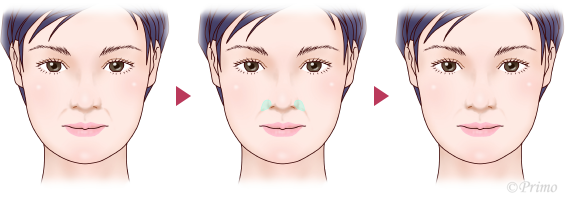
Alar base is an area at the base of the nasal alae.
A low position of the alar bases results in a face that is not three-dimensional.
It also deepens the nasolabial folds, making the person look older and the mouth appear more protruding.
Insertion of a paranasal implant can create a three-dimensional facial appearance and shallow the nasolabial folds.
Features of our paranasal augmentation
- Implants are custom shaped to fit the patient.
- Insertion of the implant is done from within the oral cavity. The scar is not noticeable on the outside.
- Surgery is performed under intravenous anesthesia to ensure a safe airway.
- The use of an endoscope protects the infraorbital nerve and minimizes the extent of dissection.
Surgery method
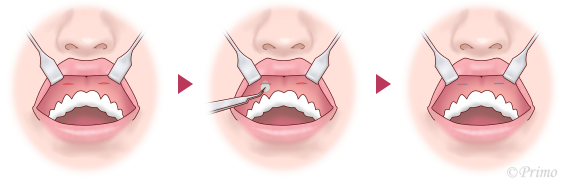
An approximately 1.5 cm incision is made in the mucosa around the canine fossa in the mouth, one incision on each side.
The subperiosteum of the maxilla is dissected to create a pocket for insertion of the paranasal implant.
A custom-made implant is inserted, formed to fit according to wishes.

Fix the implant in the optimal position.
Suture the mucous membrane incision with absorbable thread.
Endoscopic paranasal augmentation
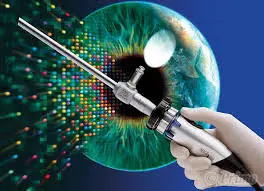
Method
The anterior buccal surface is approached through an intraoral incision or open approach, and the subperiosteum of the maxilla is dissected to create a pocket.
At this time, a Karl storz full HD endoscope is inserted to dissect the subperiosteum of the maxilla while viewing the monitor.
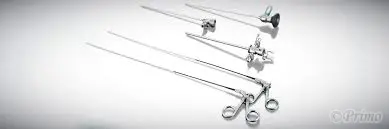
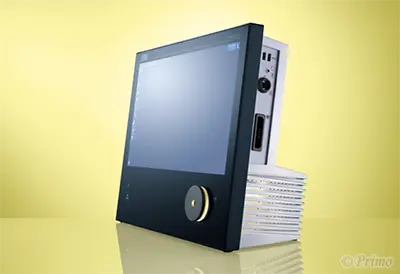
The extent of dissection will be minimized based on the size of the implant.
After insertion, the implant is checked endoscopically to ensure that there is no bending.
Dissect over the bone while preserving the infraorbital nerve.
Custom-made special order implants
When creating a custom-made special order implant, a CT scan is required in advance.
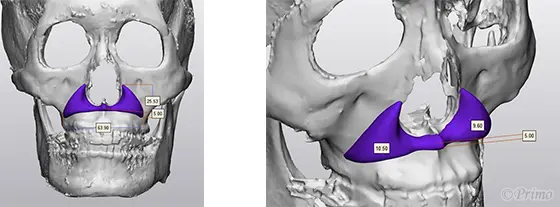
From the CT data, a model of your actual condition, and then a mold of the implant is made using resin for the desired amount of change.
A new silicone implant will be made from the mold.
The custom-made special order implant fits your own bone and is less likely to shift left to right or up and down, and the edges of the implant also migrate smoothly into the bone, preventing implant contours from showing and permanently preserving the natural form of the implant.
Of course, it is relatively easy to fine-tune the implant according to your changing needs.
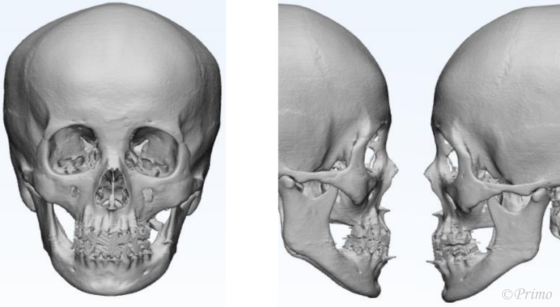
The data obtained from the CT is used to create a model of the actual situation.
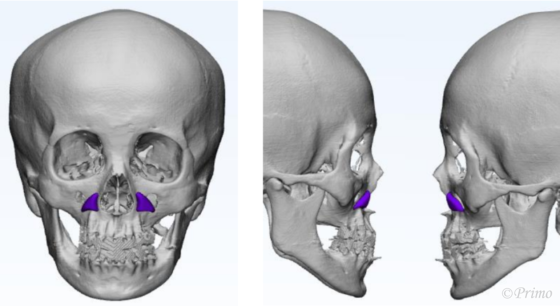
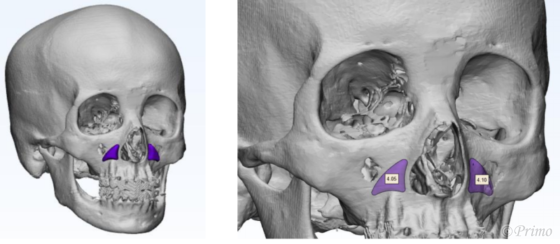
A silicone implant is designed to achieve the desired morphology.
The advantage of this integrated paranasal implant is that the implant is less likely to be displaced and can be created with or without lifting the lower part of the nose.
References and articles on paranasal augmentation
Paranasal Augmentation With Composite Graft Transfer in Overresection of Alar Base and Nostril Contracture.
Yen CI, Chang CS, Chen HC, Yang SY, Chang SY, Yang JY, Chuang SS, Hsiao YC.Ann Plast Surg. 2021 Feb 1;86(2):133-136. doi: 10.1097/SAP.0000000000002485.PMID: 32732489
Application of Patient-Specific PEEK Implant for Aesthetic Considerations in Paranasal Augmentation.
Zhang J, Li D, Liu Y, Zhang Z, Fan Y, Shi J, Liu S.J Craniofac Surg. 2022 Nov-Dec 01;33(8):e877-e880. doi: 10.1097/SCS.0000000000008824. Epub 2022 Aug 15.PMID: 35968952
Silicone Implant-Based Paranasal Augmentation for Mild Midface Concavity.
Kim JH, Jung MS, Lee BH, Jeong HS, Suh IS, Ahn DK.Arch Craniofac Surg. 2016 Mar;17(1):20-24. doi: 10.7181/acfs.2016.17.1.20. Epub 2016 Mar 21.PMID: 28913247
Videos of paranasal augmentation
Duration, downtime and aftercare of paranasal augmentation
《After surgery》
Condition of the affected area
The area around the canine fossa on both sides of the mouth is sutured.
Stitches are usually removed on the 14th day.
The insertion of a paranasal implant may cause the nose to lift and appear slightly upward after surgery, due in part to swelling.
Movement of the upper lip and cheeks can cause the implants to be misaligned.
Numbness or paralysis of the upper lip may occur.
The anesthesia may cause a sore throat.
Usually improves in a few days.
Post-operative checkup and aftercare
You will be examined by the doctor after surgery just before you go home.
Antibiotics, painkillers (the pain is usually mild, but we prescribe them just in case), and gastric medicine will be prescribed for 4 days after surgery.
Gargling with povidone-iodine (for sterilization and disinfection of the oral cavity) will be continued after the surgery.
Lifestyle advice
You can take a shower, wash your hair and face on the same day after surgery.
Please refrain from bathing for a week.
The pain is not so severe and can be adequately controlled with ordinary oral analgesics.
When brushing your teeth, please be careful not to touch the affected area with your toothbrush.
When sleeping, please use cushions to elevate your upper body.
Sleeping on your stomach or on your side is stressful to the alar base and should be avoided for the first 3 months after surgery.
Please refrain from drinking alcohol and smoking for about a week.
《Days 1-3 after surgery》【Please book an appointment for intravenous infusion】
Condition of the affected area
This is the peak time for swelling.
The swelling will subside to some extent in 7 to 10 days after surgery.
In rare cases, internal bleeding around the nasal ala may occur.
Post-operative checkup and aftercare
Intravenous antibiotics will be administered the day after surgery and on the second day.
Continue to taking prescribed oral medications and gargling.
Please inform us if you have any symptoms that may lead you to suspect side effects.
Lifestyle advice
Post-operative rest is required.
Please refrain from strenuous exercise for 1-2 months.
《2 weeks after surgery》【Please book an appointment for stitches removal or checkup】
Condition of the affected area
Due to post-operative swelling, this is the time when the base of nasal ala feels unnatural.
Over time, the swelling will gradually decrease and improve.
The bruising will usually disappear in 1-2 weeks.
Post-operative checkup and aftercare
You will be examined by a doctor.
Your stitches will be removed from the oral cavity.
Lifestyle advice
Please continue to take care not to touch the affected area with your toothbrush when brushing your teeth.
Sleeping on your stomach or on your side is stressful to the alar base and should be avoided for the first 3 months after surgery.
Please refrain from massaging the area around the alar base for 3 months.
《1 – 3 months after surgery》【It is recommended that you visit for a checkup】
Condition of the affected area
The wound will gradually heal completely, but there will be some swelling for a while.
Numbness or paralysis of the upper lip may occur.
It usually improves in 1-6 months.
Post-operative checkup and aftercare
You will be examined by a doctor.
There is no post-operative procedure.
Lifestyle advice
Please refrain from massaging the area around the alar base for 3 months.
《6 months after surgery》【It is recommended that you visit for a checkup】
Condition of the affected area
The wound has almost fully healed.
Your alar base will gradually become softer and softer.
Post-operative checkup and aftercare
You will be examined by a doctor.
There is no post-operative procedure.
Lifestyle advice
You can resume all of your daily activities, but just to be safe, protect your alar base from bumping or crushing.
FAQ
Answers to questions about paranasal augmentation.
Click on each question to see the answer.
It settles down in about a week after surgery.
Make-up can be applied immediately after surgery.
Implant can be identified by x-ray, CT, or MRI.
Our nasal surgery is basically performed under intravenous anesthesia, so you will not feel any pain.
The surgery is performed from inside the mouth, so there is no outward appearance of scarring.
Fees
| Paranasal Augmentation | ¥330,000 |
| For rib cartilage | ¥440,000 |
| Special order implant (including 3D modeling) | +¥165,000 |
All fees displayed include tax.
Normal post-operative symptoms, downtime, risks and complications
Underneath is a list of things that may occur.
In order to prevent any of these symptoms from occurring, we take safety measures and perform treatment with the utmost care.
We will always improve your symptoms.
Normal post-operative symptoms and downtime
Swelling
Swelling will go down in about 7 – 10 days.
Things will completely settle down in 4 – 6 months.
Bruising around the nose
There may be bruising around the nose.
It sometimes occurs, but it will disappear in a week or two.
Discomfort after surgery
Dull pain and discomfort may occur after surgery.
It often disappears within a few days.
Risks and complications
Wobble of implant
Movement of the upper lip and cheeks can cause the implants to be misaligned.
If necessary, revision surgery will be performed to correct the problem.
Sensory abnormalities in upper lip
Numbness or paralysis of the upper lip may occur.
It usually disappears in 1 to 6 months, but numbness may remain in rare cases.
Infection
Although rare, there is a risk of infection with any surgery.
If infection occurs, it may be necessary to treat it with intravenous antibiotics, cleaning procedures, and in some cases removal of foreign bodies.
Upturned nose
Implants placed at the alar base may lift the nose and make it appear slightly upturned.
Revision surgery is performed to adjust the orientation if necessary.
Left-right difference in nasal ala shape
A left-right difference in the shape of the nasal ala may occur after surgery.
This may be due to the original shape and size of the nose or misalignment of the implants.
We try to make the right and left sides as symmetrical as possible, but if there is a slight difference, we will correct it by revision surgery if necessary.
Rhinoplasty list
Detailed information on each rhinoplasty procedure, including case photos, case progress photos, procedure duration, post-operative course, downtime, aftercare, risks and complications.
Supervising Doctor
Under the supervision of our plastic surgeons, we operate our website in accordance with medical advertising guidelines.
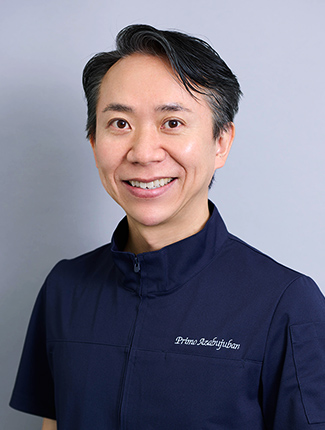
NORIHIRO OHBA M.D. Ph.D.
HEAD DIRECTOR/DIRECTOR
Qualifications and Academic Affiliations
Doctor of Medicine
Board Certified Plastic Surgeon, Japan Society of Plastic and Reconstructive Surgery
Board Certified Aesthetic Plastic Surgeon, Japanese Society of Aesthetic Plastic Surgery
Board Certified Aesthetic Plastic Surgeon, Japanese Society of Aesthetic Surgery
Anesthesiologist certified by the Ministry of Health, Labor and Welfare
Member of International Society of Aesthetic Plastic Surgery (ISAPS)
International Member of American Society of Plastic Surgeons (ASPS)
Member of Japan Society of Cranio-Maxillo Facial Surgery
Member of Japan Society of Laser Surgery and Medicine
Career
Graduated from Osaka City University Faculty of Medicine, 1996
Osaka City University Hospital Plastic and Reconstructive Surgery, 1996-1999
Osaka City University Graduate School of Medicine, 1999-2003
Osaka City University Hospital Plastic and Reconstructive Surgery, 2003-2005
Sano Memorial Hospital Plastic and Reconstructive Surgery, 2003-2005
Daito Central Hospital Plastic and Reconstructive Surgery, 2003-2005
Ritz Cosmetic Surgery Tokyo Clinic, 2005-2008
Primo Azabujuban Clinic, 2009~
Head Director, Primo Medical Corporation, 2011~
Head Director/Director, Primo Azabujuban Clinic, 2020~
