
Smaller, narrower and less noticeable nasal alae
Who is the alar base reduction suitable for?
- For those with a wide nose width
- For those with large nasal alae
- For those who are concerned about nasal alae that widen too much when smiling.
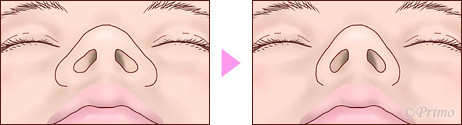
It is indicated for those who are concerned about the width of the lower half of the nose, the nose that widens too much when smiling, or the size of the nasal alae.
An explanation of the alar base reduction
Alar base reduction is a procedure to reduce the volume of the nasal alae to make them smaller or to narrow the width of the nose, for example, to reduce the size of the nasal alae or to make the nose less wide when smiling.
There are two types of alar base reduction: lateral method and medial method.
The lateral method reduces the size of the nasal ala itself by excising tissue at the alar base.
The medial method narrows the width of the nose, making it less likely to widen when smiling.
The medial method leaves a scar along the lower part of the nasal ala and the nostril rim.
Our method is to reduce the size of the nasal ala morphology as naturally as possible.
This increases the length of the scar somewhat, but it is not as noticeable due to the design of the nose, which hides the scar in the contour of the nose.
Features of our alar base reduction
- The medial method has no visible scar.
- The use of soft tissue flaps allows for a more natural approach.
- Because the soft tissues adhere to each other, there is very little retroversion.
- Surgery is performed under intravenous anesthesia, without consciousness or pain.
Surgery method
Medial and lateral methods are available.
Both methods create and retract soft tissue flaps, which is naturally smaller and narrower.
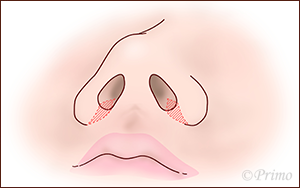
In the medial method, the nasal alae are excised within the nostrils without leaving scars on the outer side of the wings, thereby narrowing and reducing the width of the wings.
For those who are concerned about scars, this method is recommended.
The resection design is set to leave the nasal ala morphology natural.
The standard resection width is approximately 4 mm per side.
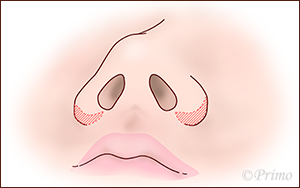
The lateral method is indicated for those with large nasal alae and strong outward projection.
Measure the distance from the center of the nasal apex evenly and adjust the left and right resection widths.
This method is highly effective because the volume of the nasal alae themselves is reduced.
The disadvantage is the scar that remains on the outside of the nasal alae.
Scarring may be somewhat noticeable due to sebaceous glands and other factors.
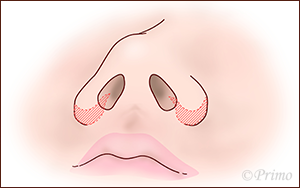
The medial plus lateral method is indicated for those with large nasal alae and strong outward projection who wish to reduce the size of the nasal alae themselves and also narrow the width of the nose.
Measure the distance from the center of the nasal apex evenly and adjust the left and right resection widths.
This method is highly effective in reducing the volume of the nasal alae themselves as well as narrowing and reducing the width of the nose.
The disadvantage is the scar that remains on the outside of the nasal alae.
Scarring may be somewhat noticeable due to sebaceous glands and other factors.
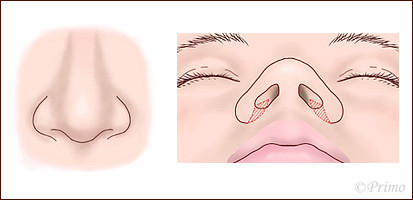
Only the skin is removed from the crescent-shaped area of the red dotted line in the above figure, leaving the soft tissue (flap).
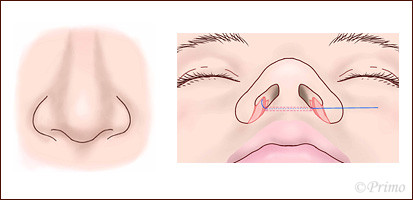
Create a tunnel at the red dotted line and retract the soft tissue (flap) on both sides.
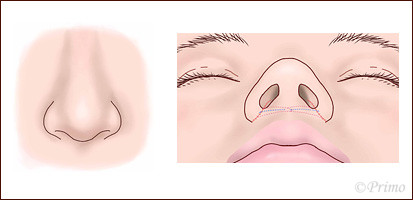
By drawing together in this way, they are brought together face to face, resulting in a more natural form.
Scars are very inconspicuous and the presence of the nose is understated.
Alar base reduction to create natural nostril morphology
Nasal ala reduction is widely performed by partial excision at the nostril floor because it can narrow the width of the nose.
The advantage of this procedure is that it narrows the width of the nose while concealing the scarring, but it can sometimes present a distinctive notching or angular nostril morphology.
At our clinic, we have devised and practice an alar base reduction that results in a natural nostril shape that is less likely to cause notching.
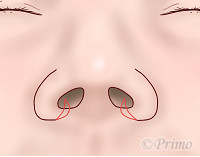
The new alar base reduction design preserves the corners of the nostril rim and aligns the resection of the nostril sill area with the margins of the nasal alae (medial method).
The width of the excision is varied according to the desired degree of reduction.
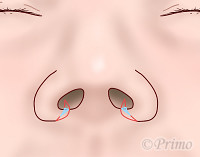
Design a triangular flap the length of the resection width within the resection area of the Nostril sill.
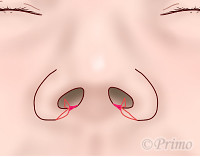
Create a design to resect the nasal floor by the same length in the footplate direction.
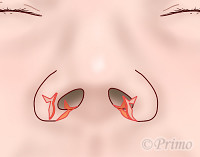
A skin incision is made with a No. 15 scalpel and the designed tissue is removed.
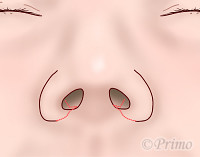
A cinching suture is used, with 4-0 PDS for the buried suture and 7-0 Nylon for the skin suture.
In cases of large overhang of the nasal alae, in addition to the excision of the nostril sill, an additional excision is made in the lateral direction of the nasal alae (lateral method).
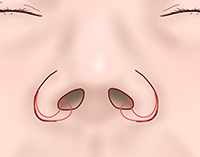
The width of the inner and outer nasal ala resection will be determined according to the patient’s wishes and condition.
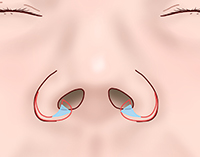
A triangular flap is designed within the resection area of the medial method.
This triangular flap portion is not resected but left in place.
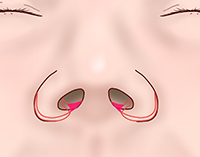
Design a triangular resection area of equal length in the direction of the columella.
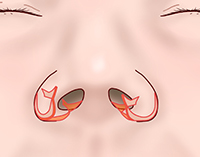
Skin excision of the nasal alae as designed from the inside to the outside.
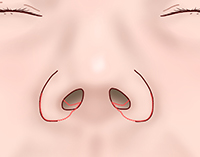
A cinching suture is used, with 4-0 PDS for the buried suture and 7-0 Nylon for the skin suture.
Revision alar base reduction
- For those who have undergone alar base reduction at another clinic but still have a large or wide nose.
- For those whose nasal alae have become too small after alar base reduction at another clinic.
- For those who have unnaturally deformed noses after alar base reduction at another clinic.
- For those who have difficulty breathing after alar base reduction.
- For those with prominent scars after alar base reduction.
This surgery corrects deformities of the nasal alae caused by trauma or alar base reduction.
Correct left-right differences in the nasal alae, too small, too large, or defects in shape.
Revision alar base reduction is performed to correct a patient who has undergone alar base reduction at another clinic, but whose nose is still too large, too wide, too small, unnaturally deformed, or it has become difficult to breathe through the nose.
For prominent scars, scar revision surgery is used to clean up the scars.
Videos of alar base reduction
Duration, downtime and aftercare of alar base reduction
《After surgery》
Condition of the affected area
The lateral method is sutured with black thread along the alar base.
Stitches are usually removed in 5-7 days.
For the medial method, the nasal cavity is sutured with blue thread.
Stitches are usually removed on the 14th day.
After surgery, the nasal tip may feel relatively rounded.
Also, due to swelling, the nasal apex may look slightly elevated.
The anesthesia may cause a sore throat.
Usually improves in a few days.
Post-operative checkup and aftercare
You will be examined by the doctor after surgery just before you go home.
Antibiotics, painkillers (the pain is usually mild, but we prescribe them just in case), and gastric medicine will be prescribed for 4 days after surgery.
Lifestyle advice
You can take a shower, wash your hair and face on the same day after surgery.
Please refrain from bathing for a week.
The pain is not so severe and can be adequately controlled with ordinary oral analgesics.
Nosebleeds or nasal discharge with blood may occur.
When doing so, do not blow your nose or stuff tissues, but wipe gently.
When sleeping, please use cushions to elevate your upper body.
Sleeping on your stomach or side is prohibited as it causes stress on the nose.
Nasal congestion may occur rarely after surgery, but will improve as the swelling goes down.
If an extremely small nose is desired, it may be hard to breathe through the nose.
There is a feeling of pulling of the nose when smiling after the surgery.
For a while, it is recommended to support the nose so that it does not widen when smiling.
Please refrain from drinking alcohol and smoking for about a week.
《Days 5 after surgery》【Please book an appointment for stitches removal】
Condition of the affected area
This is the period when the post-operative swelling causes the nasal bridge to look thicker, the tip of the nose to look rounded, and other unnatural features.
The swelling will subside to some extent in 7 to 10 days.
There may be bruising around the nose.
The bruising will usually disappear in 1-2 weeks.
Temporary sensory loss may occur at the tip of the nose and other areas.
It will improve over time.
Post-operative checkup and aftercare
There will be a medical checkup by a doctor.
Stitches around the nasal alae are removed.
Lifestyle advice
Post-operative rest is required.
Please refrain from strenuous exercise for 1-2 months.
Make-up can be applied the day after stitches are removed.
If you are concerned about redness of scars, etc., please consult with us as medical concealer is available.
Do not force the scab off.
Please wipe off nosebleeds and runny nose by pressing down lightly, and do not use cotton swabs.
Please refrain from cleaning and blowing your nose for a month after the surgery.
《2 weeks after surgery》【Please book an appointment for stitches removal or checkup】
Condition of the affected area
Swelling and internal bleeding will settle down considerably.
Redness of the scar is a normal process.
Post-operative checkup and aftercare
You will be examined by a doctor.
For the medial method, stitches will be removed from the nasal cavity.
Lifestyle advice
Please refrain from blowing your nose or pressing hard on your nose for one month.
Please refrain from touching your nose and sleeping on your stomach or side for 3 months after surgery, as it puts stress on the nose.
《1 – 3 months after surgery》【It is recommended that you visit for a checkup】
Condition of the affected area
The wound will gradually heal completely, but there will be some swelling for a while.
Post-operative checkup and aftercare
You will be examined by a doctor.
There is no post-operative medical procedure.
Lifestyle advice
After a month post-operatively, you can blow your nose and clean your nose as usual.
Please refrain from touching your nose and sleeping on your stomach or side for 3 months after surgery, as it puts stress on the nose.
The tightness when smiling will improve in 1-2 months.
It is recommended to support the nose to prevent it from spreading when smiling for a while.
《6 months after surgery》【It is recommended that you visit for a checkup】
Condition of the affected area
The wound has almost fully healed.
Your nose will gradually become softer and softer.
The feeling of a pulled nose will also be improved.
The movement is natural, even when smiling.
Post-operative checkup and aftercare
You will be examined by a doctor.
There is no post-operative medical procedure.
Lifestyle advice
You can resume all of your daily activities, but just to be safe, protect the nose from bumping or crushing.
FAQ
Answers to questions about alar base reduction.
Click on each question to see the answer.
It settles down in about a week after surgery.
Stitches are usually removed about 4-5 days after alar base reduction.
Make-up may be applied after stitches are removed.
Our nasal surgery is basically performed under intravenous anesthesia, so you will not feel any pain.
If surgery under local anesthesia is desired, block anesthesia is used in combination with anesthesia to minimize the pain of administering anesthesia.
In the lateral excision for nasal ala reduction, the rim of the nose is cut to make it smaller, leaving a scar on the side of the nose, but it is not very noticeable.
For those who are concerned about scarring, medial resection is recommended.
In the case of a simple method such as using threads to pull the nasal alae together, there is a possibility of regression, but in our alar base reduction , after skin excision, the soft tissue is formed into a flap and pulled in, so once the shape is stable, it will not regress.
Fees
| Alar Base Reduction | Medial method | ¥330,000 |
|---|---|---|
| Lateral Method | ¥330,000 | |
| Medial Method + Lateral Method | ¥495,000 |
All fees displayed include tax.
Normal post-operative symptoms, downtime, risks and complications
Underneath is a list of things that may occur.
In order to prevent any of these symptoms from occurring, we take safety measures and perform treatment with the utmost care.
We will always improve your symptoms.
Normal post-operative symptoms and downtime
Swelling
Swelling will go down in 7 – 10 days after surgery.
Things will completely settle down in about 6 months.
The upper lip may swell.
Bruising around the nose
There may be bruising around the nose.
It sometimes occurs, but it will disappear in a week or two.
Discomfort after surgery
Dull pain and discomfort may occur after surgery.
The tightness when smiling will improve in 1-2 months.
Nasal bleeding
Nasal bleeding may occur after surgery.
Do not put fingers or other objects in the nostrils.
Dull sensation at the tip of the nose
Postoperatively, there may be a dulling of sensation at the tip of the nose, but this is often temporary.
It will improve over time.
Risks and complications
Left-right difference in nasal tip after surgery
Perfect left-right symmetry is difficult to achieve because the human face originally has left-right differences.
If correctable by surgery, corrective surgery will be performed.
Nasal congestion
Rarely, nasal congestion may occur after surgery, but it will improve as the swelling goes down.
If an extremely small nose is desired, it may be difficult to breathe through the nose.
If nasal congestion does not improve, surgery may be required to improve it.
Infection
Although rare, there is a risk of infection with any surgery.
If infection occurs, it may be necessary to treat the infection with antibiotics or, in the case of pus accumulation, to perform a small incisional drainage to remove the source of infection.
Scar
Scars are left at the alar base.
Scarring may be somewhat noticeable due to sebaceous glands and other factors.
If correctable by surgery, corrective surgery will be performed.
Nasal tip is thick, not feeling the effects of surgery
After surgery, the nasal tip may feel relatively rounded.
Also, the nasal apex may look slightly elevated.
Bulbous tip correction, etc. will be performed if necessary.
Rhinoplasty list
Detailed information on each rhinoplasty procedure, including case photos, case progress photos, procedure duration, post-operative course, downtime, aftercare, risks and complications.
Supervising Doctor
Under the supervision of our plastic surgeons, we operate our website in accordance with medical advertising guidelines.
NORIHIRO OHBA M.D. Ph.D.
HEAD DIRECTOR/DIRECTOR

Qualifications and Academic Affiliations
Doctor of Medicine
Board Certified Plastic Surgeon, Japan Society of Plastic and Reconstructive Surgery
Board Certified Aesthetic Plastic Surgeon, Japanese Society of Aesthetic Plastic Surgery
Board Certified Aesthetic Plastic Surgeon, Japanese Society of Aesthetic Surgery
Anesthesiologist certified by the Ministry of Health, Labor and Welfare
Member of International Society of Aesthetic Plastic Surgery (ISAPS)
International Member of American Society of Plastic Surgeons (ASPS)
Member of Japan Society of Cranio-Maxillo Facial Surgery
Member of Japan Society of Laser Surgery and Medicine
Career
Graduated from Osaka City University Faculty of Medicine, 1996
Osaka City University Hospital Plastic and Reconstructive Surgery, 1996-1999
Osaka City University Graduate School of Medicine, 1999-2003
Osaka City University Hospital Plastic and Reconstructive Surgery, 2003-2005
Sano Memorial Hospital Plastic and Reconstructive Surgery, 2003-2005
Daito Central Hospital Plastic and Reconstructive Surgery, 2003-2005
Ritz Cosmetic Surgery Tokyo Clinic, 2005-2008
Primo Azabujuban Clinic, 2009~
Head Director, Primo Medical Corporation, 2011~
Head Director/Director, Primo Azabujuban Clinic, 2020~
