
It makes you look younger
Reduces wrinkles and bags and gives a more balanced look
Lower blepharoplasty with septal reset (Hamra technique) explained
Lower blepharoplasty with septal reset (Hamra technique) is a technique to improve the morphology of age-related flabby skin and fat protrusion of the lower eyelid by excising sagging skin and transferring fat.
The lower eyelid is a thin area of skin that tends to show wrinkles and sagging as it ages.
Lower eyelid puffiness, also known as eyebags, is caused by orbital fat that has moved forward with aging.
The fat in the cheeks can also droop, creating a hollow under the eyelid puffiness.
Lower blepharoplasty with septal reset (Hamra technique) can reduce fine lines and wrinkles by excising sagging skin at the eyelash line, and the Hamra technique can additionally move orbital fat into the midcheek groove to make it shallower and eye bags less noticeable.
Features of our lower blepharoplasty with septal reset (Hamra technique)
- For local anesthesia, we use 34G ultra-fine needles (needle thickness 0.2mm) to minimize pain.
- Surface anesthesia and intravenous anesthesia are used for those who are afraid of even the slightest pain.
- Skin sutures can be removed early on the fourth or fifth day, because we use the buried suture method with 7-0 ultra-fine absorbable thread. Scarring will be minimal.
- Skin suturing with transparent thread is also available.
- The fat is firmly moved downward and fixed to improve eyebags and deep wrinkles.
- The orbicularis oculi muscle is lifted to prevent ectropion.
- You can apply make-up to your lower eyelids the day after your stitches are removed.
Surgical method
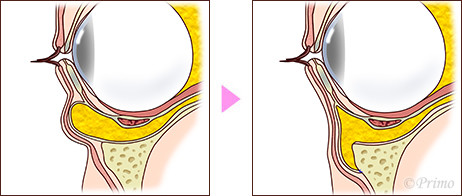
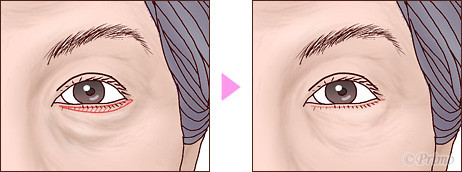
Sagging skin is removed by excising the skin at the eyelash line. Care must be taken not to remove too much, as over-resection can lead to ectropion.
After excision of the skin, the area under the orbicularis oculi muscle is dissected to expose the orbital fat. Excess orbital fat can be removed, but it can also be transferred to the hollow area under the eyes to help improve the hollows, thus killing two birds with one stone by using the Hamra technique.
After the fat is moved, the orbicularis oculi muscle is pulled outward to tighten the lower eyelid. If there is still excess skin at this point, additional excisions are made.
For optimal healing, the wound is internally sutured with high-performance absorbable ultra-fine thread and externally sutured with non-absorbable ultra-fine thread.
We also offer skin suturing with ultra-fine transparent thread.
If you wish to have more firmness across the cheeks, fat injections or hyaluronic acid injections can be used to further rejuvenate the cheeks.
Aftercare for lower blepharoplasty with septal reset (Hamra technique)
《After surgery》
Condition of the affected area
The lower eyelash line is sutured with an ultra fine black thread. Stitches are usually removed in 5-7 days.
Edema may cause the whites of the eyes to temporarily turn jelly-like, but this will disappear over time.
Bruising may occur, and sometimes in the white part of the eye. It will all disappear in 1-2 weeks.
Swelling may cause the eyelid to slightly turn outward. The degree varies from person to person, but it settles down in about 3-6 months.
Tears may flow easily after surgery. This can occur when the lacrimal canal is narrowed due to post-operative swelling. It will improve as the swelling goes down.
There may be a slight tendency toward slanted eyes. Stiffness and discomfort of the eyelids may occur.
Post-operative checkup and aftercare
You will be examined by the doctor just before you go home after surgery.
Antibiotics, painkillers (the pain is usually mild, but we prescribe them just in case) and gastric medicine will be prescribed for 3 days after surgery.
Lifestyle advice
You can wash your hair and take a shower on the same day after surgery.
Please only wash your face with water, not soap. You can use soap or facial cleansing foam from the next day onwards. However, please do not rub the wound. If the thread gets stuck or it tears, it may bleed. Please do not pick the scab or any other part of the wound, and try to rest.
Please refrain from taking a bath or doing any strenuous exercise for about a week.
Make-up can be applied on the same day after surgery except around the wound. Please do not apply any make-up to the affected area until the stitches are removed.
When sleeping, please use cushions to elevate your upper body and head.
Please refrain from drinking alcohol and smoking for about a week.
Contact lenses can be worn from the third day after surgery if there is no discomfort. However, please refrain from wearing them if you have conjunctival swelling.
《Days 5-7 after surgery》【It is recommended that you visit for a checkup at this time】
Condition of the affected area
Swelling will go down in a week or two.
Initially, the scar will be red. The redness varies from person to person, but it will subside in 1-2 months.
Bruising may occur, and sometimes in the white part of the eye. It will disappear in 1-2 weeks.
Tears may flow easily after surgery. This can occur when the lacrimal canal is narrowed due to post-operative swelling. It will improve as the swelling goes down.
Post-operative checkup and aftercare
You will be examined by a doctor, and your stitches will be removed.
Lifestyle advice
Eye make-up, skin lotions and creams can be applied after stitches removal.
Please avoid rubbing the eye area too much.
From the 7th day after surgery, you will be able to bathe and exercise as usual.
After removal of stitches, please keep the scar moisturized and UV protected. Our wound cream (1,100 yen inc. tax) can be applied to make the wound less prominent.
《1-3 months after surgery》【It is recommended that you visit for a checkup at this time】
Condition of the affected area
The wound will gradually heal completely, but there will be some swelling for a while.
The redness varies from person to person, but it will subside in 1-2 months.
Transferred fat is also hard at first. If the amount of fat transferred is insufficient, hyaluronic acid injections or fat injections may be required.
Post-operative checkup and aftercare
You will examined by a doctor.
There is no post-operative procedure.
Lifestyle advice
Please continue to moisturize and UV-protect your scars.
《6 months after surgery》【It is recommended that you visit for a checkup at this time】
Condition of the affected area
The wound has almost fully healed.
Post-operative checkup and aftercare
You will examined by a doctor.
There is no post-operative procedure.
Lifestyle advice
You can resume all of your daily activities.
FAQ
For 1-3 months after surgery, there will be some redness and stiffness. Redness can be concealed with make-up.
If it becomes persistent, we will provide appropriate treatment at the post-operative checkup (free of charge).
Make-up can be applied on the day of surgery except for the surgical site.
Stitches are usually removed 5 days after surgery.
The day after they are removed, you can apply make-up to your lower eyelids.
About 1-2 weeks, usually.
Post-operative pain is usually very mild.
We will prescribe a mild analgesic and anti-inflammatory drugs just in case.
About 2 hours.
Bruising sometimes occurs.
If it appears on the skin, concealer can be used. If bruising appears on the sclera, it will take 1-2 weeks to clear.
We always prescribe eye drop and eye ointment for dry eyes.
Pain will be minimal because our local anesthetic contains extra agents to reduce any discomfort.
To minimize injection pain, the amount of anesthetic used is kept to a minimum of 1-1.5 cc for both eyelids.
Pain is also minimized by using an ultra-fine 34G needle, as well as a new needle for each eyelid, and by administering the local anesthetic very slowly.
For those who are still afraid of pain, we offer intravenous anesthesia, where you will be unconscious and breathing as usual.
Fees
| Lower Blepharoplasty with Septal Reset (Hamra technique) | ¥550,000 |
|---|
All fees displayed include tax.
Risks and side effects of lower blepharoplasty with septal reset (Hamra technique)
Underneath is a list of things that may occur.
In order to prevent any of these symptoms from occurring, we take safety measures and perform treatment with the utmost care.
We will always improve your symptoms.
Normal post-operative symptoms
Swelling
Swelling will go down in 1-2 weeks.
Bruising
There may be bruising around the eye, and occasionally it appears in the white part of the eye.
Any bruising will disappear in a week or two.
Eyelid discomfort
Immediately after lower blepharoplasty with septal reset (Hamra technique), the eyelids will feel strange, but this will disappear over time.
Scar redness
It remains on the eyelash line.
You will see some redness for 1-2 months after surgery, but it will become less noticeable over time.
Perceptual abnormalities
Feeling may be dulled on the lower eyelid after surgery, but this is mostly temporary.
Risks and complications
Exposure of buried absorbable sutures
If this happens, we will remove them.
Swelling of the whites of the eyes
Swelling may cause the whites of the eyes to temporarily turn jelly-like, but this will disappear over time.
We prescribe eye drops and eye ointment to accelerate hearing.
Ectropion
Post-operative swelling and excessive skin removal may cause eyelid ectropion.
The degree varies from person to person, but it settles down in about 3-6 months.
If there is no improvement, skin grafting may be necessary.
Bags under the eyes
This surgery improves bags under the eyes, but the color of the skin will remain the same.
In addition, fine lines and sagging will not disappear completely.
Too much skin removal increases the risk of ectropion, so the optimal amount of resection is determined according to the situation.
Double vision
This can occur when the extraocular muscles are damaged by surgery.
Dry eyes
As the eyelids become larger and the eyes open more easily, they may dry out more easily.
Epiphora
Tears may flow easily after surgery.
This can occur when the lacrimal canal is narrowed due to post-operative swelling.
It will improve as the swelling goes down.
Changes in eyelid morphology
There may be a slight tendency toward slanted eyes after surgery.
Stiffness and discomfort of the eyelids may occur.
Transferred fat is also hard at first.
If the amount of fat transferred is insufficient, hyaluronic acid injections or fat injections may be required.
Sagging remains
Fine lines and sagging skin will not disappear completely.
Too much skin removal increases the risk of ectropion, so the optimal amount of resection is determined according to the situation.
Eyelid surgery (blepharoplasty) list
Detailed information on each eye surgery procedure, including case photos, case progress photos, procedure duration, post-operative course, downtime, aftercare, risks, side effects, and complications.
Supervising Doctor
Under the supervision of our plastic surgeons, we operate our website in accordance with medical advertising guidelines.
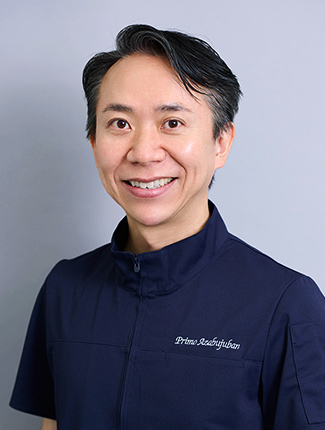
NORIHIRO OHBA M.D. Ph.D.
HEAD DIRECTOR/DIRECTOR
Qualifications and Academic Affiliations
Doctor of Medicine
Board Certified Plastic Surgeon, Japan Society of Plastic and Reconstructive Surgery
Board Certified Aesthetic Plastic Surgeon, Japanese Society of Aesthetic Plastic Surgery
Board Certified Aesthetic Plastic Surgeon, Japanese Society of Aesthetic Surgery
Anesthesiologist certified by the Ministry of Health, Labor and Welfare
Member of International Society of Aesthetic Plastic Surgery (ISAPS)
International Member of American Society of Plastic Surgeons (ASPS)
Member of Japan Society of Cranio-Maxillo Facial Surgery
Member of Japan Society of Laser Surgery and Medicine
Career
Graduated from Osaka City University Faculty of Medicine, 1996
Osaka City University Hospital Plastic and Reconstructive Surgery, 1996-1999
Osaka City University Graduate School of Medicine, 1999-2003
Osaka City University Hospital Plastic and Reconstructive Surgery, 2003-2005
Sano Memorial Hospital Plastic and Reconstructive Surgery, 2003-2005
Daito Central Hospital Plastic and Reconstructive Surgery, 2003-2005
Ritz Cosmetic Surgery Tokyo Clinic, 2005-2008
Primo Azabujuban Clinic, 2009~
Head Director, Primo Medical Corporation, 2011~
Head Director/Director, Primo Azabujuban Clinic, 2020~
