
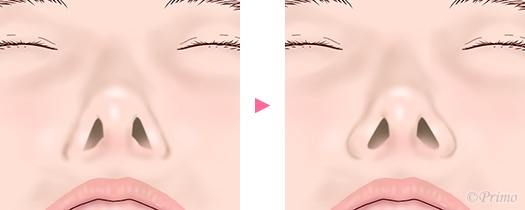
This surgery corrects deformities of the nasal alae caused by alar base reduction and other surgeries.
Skin or scar excision, skin soft tissue transfer, and transplantation of skin-cartilage composite tissue or cartilage are used to reshape the nasal alae to approximate the natural shape of the wings.
Features of our revision alar base reduction
- If necessary, cartilage grafts, skin soft tissue transplantation, etc. are combined.
- Optimal excision of scars and skin.
- Surgery is performed under intravenous anesthesia, without consciousness or pain.
Surgery method
Minimal excision of skin and scar tissue.
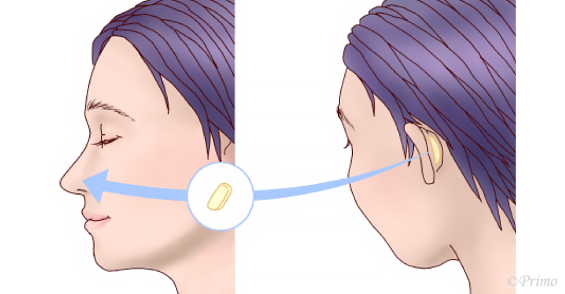
If there is a tissue defect in the nasal alae, skin and soft tissue transfer or grafting of skin, soft tissue, or cartilage can be used to reshape the nasal alae.
Suture fixation to stabilize the grafted tissue.
At this time, cinching sutures at the alar base can be used to relax the tension on the wound and minimize scarring.
Retainer is fixed and the surgery is completed.
Symptoms
One of the most common symptoms of nasal ala deformity after aesthetic surgery is an angular form of notching of the nostril rim.
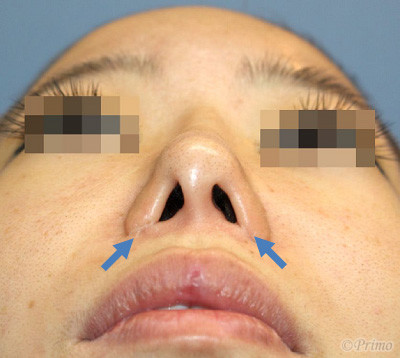
Nasal ala deformity with notching of the nostril rim (blue arrow) is also called teardrop deformity.
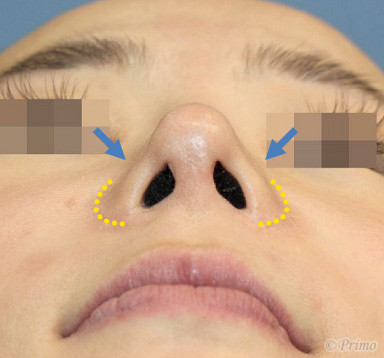
Other typical symptoms include obscuration of the alar groove (yellow area) and flattening of the nasal alae (blue arrows).
This can cause an imbalance between the nose and the face, causing discomfort.
To correct the above symptoms, we offer aesthetic surgical treatment with a focus on auricular cartilage grafting.
If necessary, flap plasty or skin-cartilage composite tissue transplantation is used to correct the deformed nasal ala morphology.
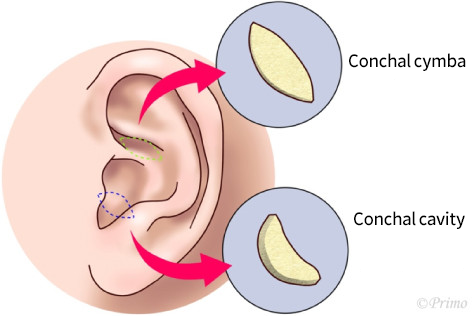
The conchal cavity and conchal cymba are the sites of choice for cartilage harvesting for transplantation.
If this site cannot be employed for any reason, other parts of the auricular cartilage can be used.
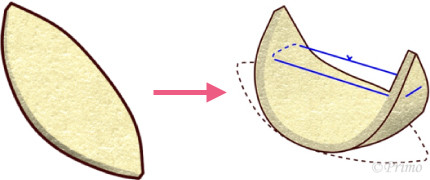
The graft from the conchal cymba is somewhat straight, but because the cartilage is flexible, it is formed into a curved cartilage graft using 5-0 Nylon thread.
Curved cartilage graft
Typical symptom-relieving correction involves local flap-plasty using the excess skin on the outside of the nasal alae.
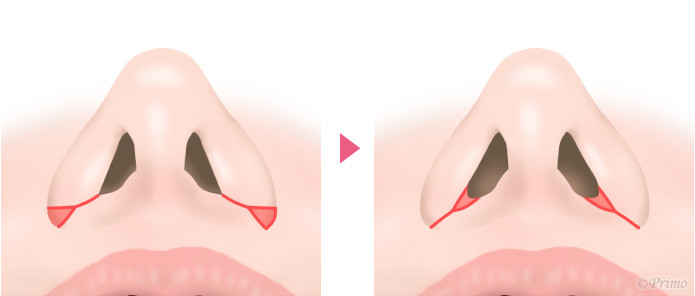
Cartilage harvested from the auricle is transplanted.
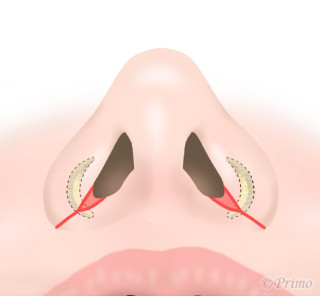
The cartilage grafts are then rounded using mattress sutures with 5-0 Nylon thread to create a curved cartilage graft,The graft is then transplanted into the subcutaneous pocket of the nasal ala.
This clarifies the alar groove and reconstructs the natural roundness of the nasal ala curves.
Adjust the width of the nasal alae using cinching suture if necessary.
Videos of revision alar base reduction
References and articles on revision alar base reduction
Inferiorly Based Alar Groove Flap for Correction of Alar Base Malposition and Nasal Stenosis.
Patel N, Horriat NL, Brownlee P, Humphries L, Hoppe IC.Plast Reconstr Surg Glob Open. 2022 May 18;10(5):e4334. doi: 10.1097/GOX.0000000000004334. eCollection 2022 May.PMID: 35620505
The External Nasal Valve.
Hamilton GS 3rd.Facial Plast Surg Clin North Am. 2017 May;25(2):179-194. doi: 10.1016/j.fsc.2016.12.010. Epub 2017 Feb 20.PMID: 28340649
Managing Alar Flare in Rhinoplasty.
Rohrich RJ, Malafa MM, Ahmad J, Basci DS.Plast Reconstr Surg. 2017 Nov;140(5):910-919. doi: 10.1097/PRS.0000000000003786.PMID: 29068925
A Novel Technique for Nasal Alar Reconstruction.
Nadjmi N, Vaes L, Van de Casteele E.Plast Reconstr Surg Glob Open. 2022 Apr 22;10(4):e4284. doi: 10.1097/GOX.0000000000004284. eCollection 2022 Apr.PMID: 35475282
Nasal base surgery.
Bohluli B, Moharamnejad N, Yamani A.Oral Maxillofac Surg Clin North Am. 2012 Feb;24(1):87-94. doi: 10.1016/j.coms.2011.10.009.PMID: 22284399
Duration, downtime and aftercare of revision alar base reduction
《After surgery》
Condition of the affected area
Sutures are placed along the alar base with black thread.
Stitches are usually removed in 7 days.
If there is a tissue defect in the nasal alae, skin and soft tissue transfer or grafting of skin, soft tissue, or cartilage can be used to reshape the nasal alae.
The nasal ala area may feel rounder, thicker, or stiffer than before surgery.
The anesthesia may cause a sore throat.
Usually improves in a few days.
Post-operative checkup and aftercare
You will be examined by the doctor after surgery just before you go home.
Antibiotics, painkillers (the pain is usually mild, but we prescribe them just in case), and gastric medicine will be prescribed for 4 days after surgery.
Lifestyle advice
You can take a shower, wash your hair and face on the same day after surgery.
Please refrain from bathing for a week.
The pain is not so severe and can be adequately controlled with ordinary oral analgesics.
Nosebleeds or nasal discharge with blood may occur.
When doing so, do not blow your nose or stuff tissues, but wipe gently.
When sleeping, please use cushions to elevate your upper body.
Sleeping on your stomach or side is prohibited as it causes stress on the nose.
Nasal congestion may occur rarely after surgery, but will improve as the swelling goes down.
There is a feeling of pulling of the nose when smiling after the surgery.
For a while, it is recommended to support the nose so that it does not widen when smiling.
Please refrain from drinking alcohol and smoking for about a week.
《Days 7 after surgery》【Please book an appointment for stitches removal】
Condition of the affected area
This is the period when the post-operative swelling causes the nasal bridge to look thicker, the tip of the nose to look rounded, and other unnatural features.
The swelling will subside to some extent in 7 to 10 days.
There may be bruising around the nose.
The bruising will usually disappear in 1-2 weeks.
Temporary sensory loss may occur at the tip of the nose and other areas.
It will improve over time.
Post-operative checkup and aftercare
There will be a medical checkup by a doctor.
Stitches will be removed from the outside of the nose.
Lifestyle advice
Post-operative rest is required.
Please refrain from strenuous exercise for 1-2 months.
Make-up can be applied from the next day.
If you are concerned about redness of scars, etc., please consult with us as medical concealer is available.
Do not force the scab off.
Please wipe off nosebleeds and runny nose by pressing down lightly, and do not use cotton swabs.
Please refrain from cleaning and blowing your nose for a month after the surgery.
《2 weeks after surgery》【Please book an appointment for stitches removal or checkup】
Condition of the affected area
Swelling and internal bleeding will settle down considerably.
Redness of the scar is a normal process.
Post-operative checkup and aftercare
You will be examined by a doctor.
Lifestyle advice
Please refrain from blowing your nose or pressing hard on your nose for one month.
Please refrain from touching your nose and sleeping on your stomach or side for 3 months after surgery, as it puts stress on the nose.
《1 – 3 months after surgery》【It is recommended that you visit for a checkup】
Condition of the affected area
The wound will gradually heal completely, but there will be some swelling for a while.
Post-operative checkup and aftercare
You will be examined by a doctor.
There is no post-operative medical procedure.
Lifestyle advice
After a month post-operatively, you can blow your nose and clean your nose as usual.
Please refrain from touching your nose and sleeping on your stomach or side for 3 months after surgery, as it puts stress on the nose.
The tightness when smiling will improve in 1-2 months.
It is recommended to support the nose to prevent it from spreading when smiling for a while.
《6 months after surgery》【It is recommended that you visit for a checkup】
Condition of the affected area
The wound has almost fully healed.
Your nose will gradually become softer and softer.
The feeling of a pulled nose will also be improved.
Post-operative checkup and aftercare
You will be examined by a doctor.
There is no post-operative medical procedure.
Lifestyle advice
You can resume all of your daily activities, but just to be safe, protect the nose from bumping or crushing.
FAQ
Answers to questions about revision alar base reduction.
Click on each question to see the answer.
It settles down in about a week after surgery.
Stitches are usually removed about 5-7 days after alar base reduction.
Make-up may be applied after stitches are removed.
Our nasal surgery is basically performed under intravenous anesthesia, so you will not feel any pain.
If surgery under local anesthesia is desired, block anesthesia is used in combination with anesthesia to minimize the pain of administering anesthesia.
In the revision alar base reduction, the rim of the nose is cut to make it smaller, leaving a scar on the side of the nose, but it is not very noticeable.
Our clinic uses plastic surgical sutures with absorbable thread, so post-operative scars are less noticeable and clean.
Although some early post-operative retroversion is possible, our revision alar base reduction does not cause retroversion once a stable shape is achieved because the skin and cartilage are appropriately removed, moved, or grafted.
Retainer will also be used to prevent retrogression.
Fees
| Revision Alar Base Reduction | ¥330,000 |
| Complex surgery involving tissue transfer or grafting | ¥550,000 |
All fees displayed include tax.
Normal post-operative symptoms, downtime, risks and complications
Underneath is a list of things that may occur.
In order to prevent any of these symptoms from occurring, we take safety measures and perform treatment with the utmost care.
We will always improve your symptoms.
Normal post-operative symptoms and downtime
Swelling
Swelling will go down in 7 – 10 days after surgery.
Things will completely settle down in about 6 months.
The upper lip or cheeks may swell.
Bruising around the nose
There may be bruising around the nose.
It sometimes occurs, but it will disappear in a week or two.
Discomfort after surgery
Dull pain and discomfort may occur after surgery.
The tightness when smiling will improve in 1-2 months.
Nasal bleeding
Nasal bleeding may occur after surgery.
Do not put fingers or other objects in the nostrils.
Dull sensation at the tip of the nose
Postoperatively, there may be a dulling of sensation at the tip of the nose, but this is often temporary.
It will improve over time.
Risks and complications
Left-right difference in nasal tip after surgery
Perfect left-right symmetry is difficult to achieve because the human face originally has left-right differences.
If correctable by surgery, corrective surgery will be performed.
Nasal congestion
Rarely, nasal congestion may occur after surgery, but it will improve as the swelling goes down.
If nasal congestion does not improve, surgery may be required to improve it.
Infection
Although rare, there is a risk of infection with any surgery.
If infection occurs, it may be necessary to treat the infection with antibiotics or, in the case of pus accumulation, to perform a small incisional drainage to remove the source of infection.
In case of tissue insufficiency, re-grafting will be performed to correct.
Scar
Scars are left at the alar base.
Scarring may be somewhat noticeable due to sebaceous glands and other factors.
If correctable by surgery, corrective surgery will be performed.
Nasal tip is thick, not feeling the effects of surgery
After surgery, the nasal ala may feel relatively rounded.
Surgical correction is performed as necessary.
Thickening of the nasal ala area
After surgery, the nasal ala area may feel relatively thicker due to tissue transplantation.
Surgical correction is performed as necessary.
Stiffening of the nasal ala area
The nasal ala area may feel relatively stiff after surgery.
Surgical correction is performed as necessary.
Rhinoplasty list
Detailed information on each rhinoplasty procedure, including case photos, case progress photos, procedure duration, post-operative course, downtime, aftercare, risks and complications.
Supervising Doctor
Under the supervision of our plastic surgeons, we operate our website in accordance with medical advertising guidelines.
NORIHIRO OHBA M.D. Ph.D.
HEAD DIRECTOR/DIRECTOR
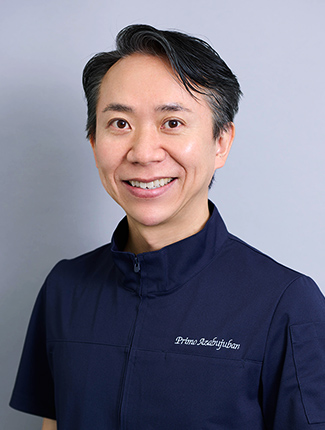
Qualifications and Academic Affiliations
Doctor of Medicine
Board Certified Plastic Surgeon, Japan Society of Plastic and Reconstructive Surgery
Board Certified Aesthetic Plastic Surgeon, Japanese Society of Aesthetic Plastic Surgery
Board Certified Aesthetic Plastic Surgeon, Japanese Society of Aesthetic Surgery
Anesthesiologist certified by the Ministry of Health, Labor and Welfare
Member of International Society of Aesthetic Plastic Surgery (ISAPS)
International Member of American Society of Plastic Surgeons (ASPS)
Member of Japan Society of Cranio-Maxillo Facial Surgery
Member of Japan Society of Laser Surgery and Medicine
Career
Graduated from Osaka City University Faculty of Medicine, 1996
Osaka City University Hospital Plastic and Reconstructive Surgery, 1996-1999
Osaka City University Graduate School of Medicine, 1999-2003
Osaka City University Hospital Plastic and Reconstructive Surgery, 2003-2005
Sano Memorial Hospital Plastic and Reconstructive Surgery, 2003-2005
Daito Central Hospital Plastic and Reconstructive Surgery, 2003-2005
Ritz Cosmetic Surgery Tokyo Clinic, 2005-2008
Primo Azabujuban Clinic, 2009~
Head Director, Primo Medical Corporation, 2011~
Head Director/Director, Primo Azabujuban Clinic, 2020~
