
Who is the tip rhinoplasty suitable for?
- Those who want to slightly reshape the tip of the nose.
- Those who wish to correct the shape of the nasal tip naturally.
An explanation of the tip rhinoplasty
Our tip rhinoplasty is basically a procedure used for fine-tuning and correction of patients who have undergone caudal septal extension graft.
It is used for various requests, such as to make the nasal tip a little thinner, a little thicker, more natural, a little higher, or a little more oriented.
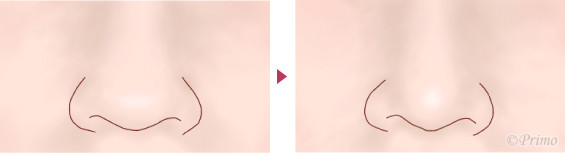
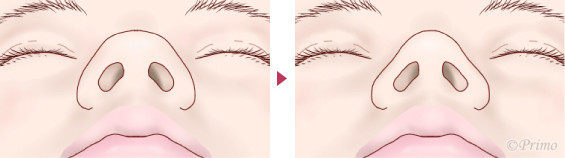
In addition to excision of nasal tissue, cartilage is harvested from areas other than the nose, such as auricular cartilage and rib cartilage, and grafted to the nasal tip to create the desired shape, or soft tissue is grafted to the nasal tip using fat graft, dermal fat graft, or fascia graft.
This may be done to correct a previous surgery.
Features of our tip rhinoplasty
- When the closed approach is used, the wound is only in the nasal cavity and is not noticeable. This may be done with an open approach.
- Optimal fat removal, cartilage excision, and suturing of the grafted cartilage.
- Combination of cartilage and soft tissue grafting as needed.
- The surgery is performed under intravenous anesthesia, so there is no need to worry about pain or fear.
Surgical procedure
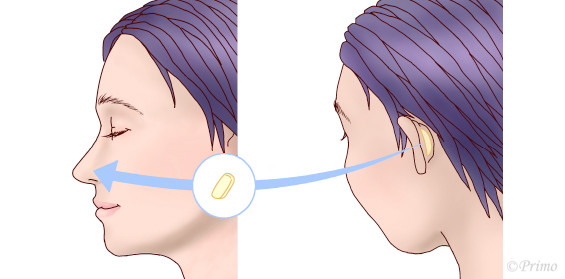
A minimum amount of auricular cartilage or rib cartilage is harvested and grafted into the nose.
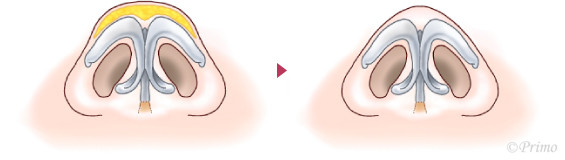
Open or closed rhinoplasty are available.
Remove excess tissue from the nasal tip.
Depending on the thickness of the skin and the size of the cartilage in the nose, the cartilage is sutured.
Cartilage and soft tissue grafts are combined as needed.
The surgery takes approximately 1 hour and 30 minutes.
The cast will be immobilized for about 5 days after the surgery.
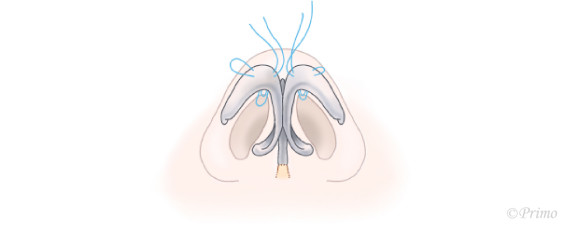
Suture the middle leg of the nasal ala cartilage to accentuate and strengthen the nasal tip (dome suture)
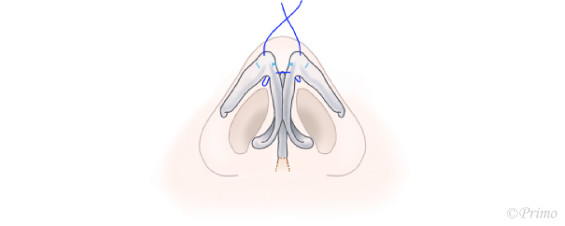
If necessary, the nasal ala cartilage is pulled in (interdomal suture).
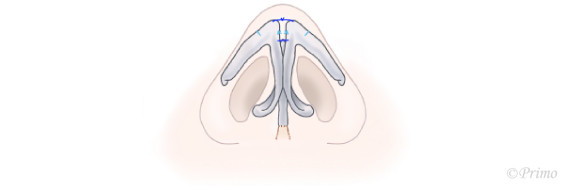
This forms a narrower nasal tip.
There are various methods of cartilage grafting to adjust the nasal tip
Our tip rhinoplasty is based on a caudal septal extension graft and includes various cartilage, fat, and soft tissue grafting techniques to create the desired nose shape.
Typical cartilage grafting techniques are presented below.
1.Lateral crural graft
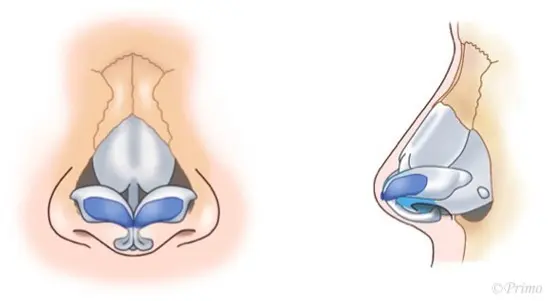
This is used to naturally adjust the nasal tip that has become too thin.
2.Rim graft
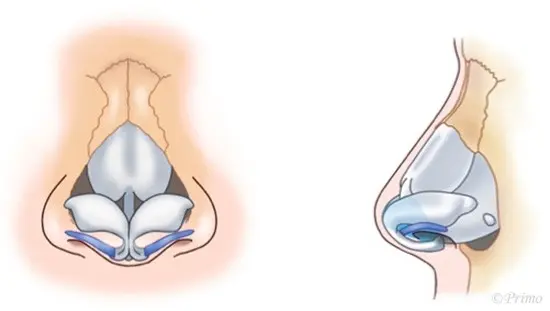
This may be used to correct pinch noses.
3.Columellar graft
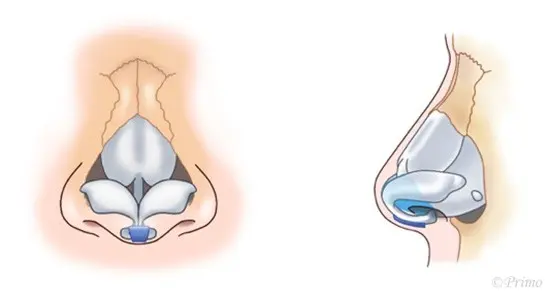
This is used when you want to lower the columella more firmly.
If you are particular about the shape of your columella, we can also shape it to be close to your desired shape.
It will also have the effect of shortening the bridge of the nose.
4.Shield graft
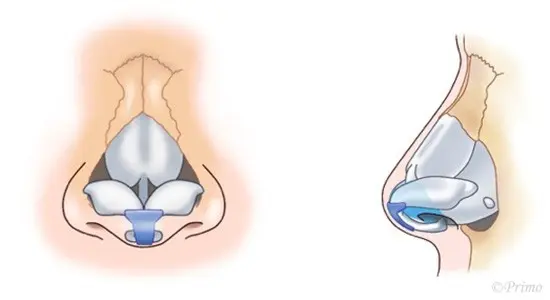
This has the effect of producing the nasal tip from the upper part of the columella in a diagonal downward direction.
It is sometimes used to form a so-called rectangular nasal tip viewed from the side, where the nasal tip is not straight from the base of the columella.
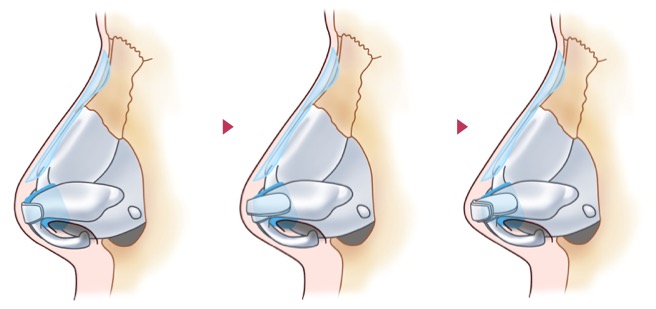
5.Onlay cap graft
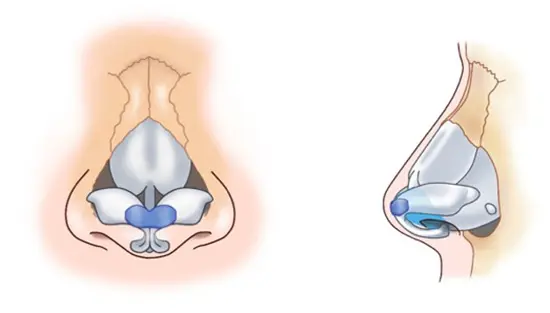
This is used when a little more height is desired at the nasal tip.
It also makes the nasal tip look slender.
It may be used for fine-tuning to achieve the desired nasal tip orientation.

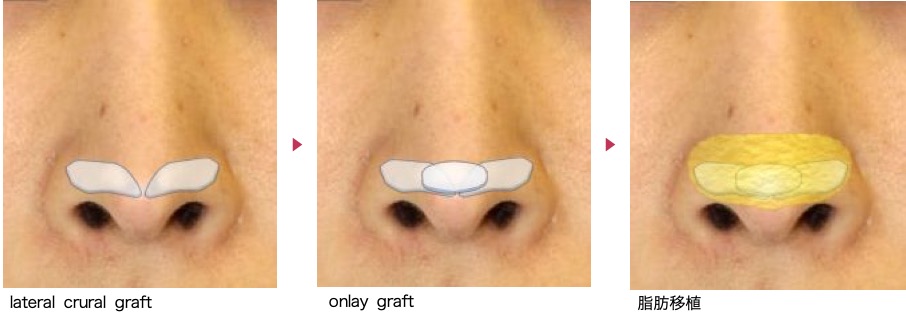
One method to improve a pinch nose is lateral crural graft.
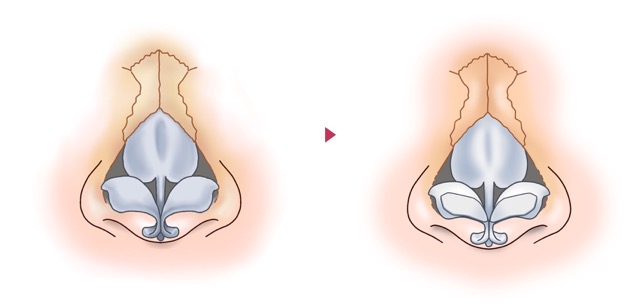
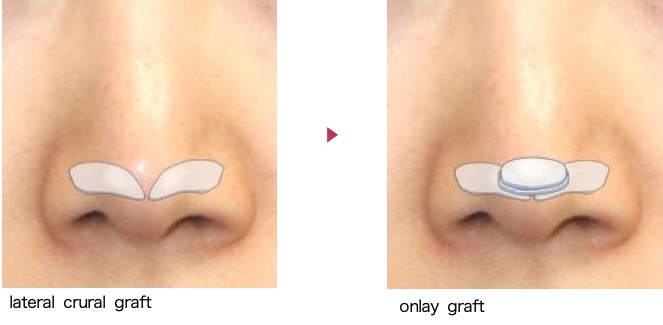
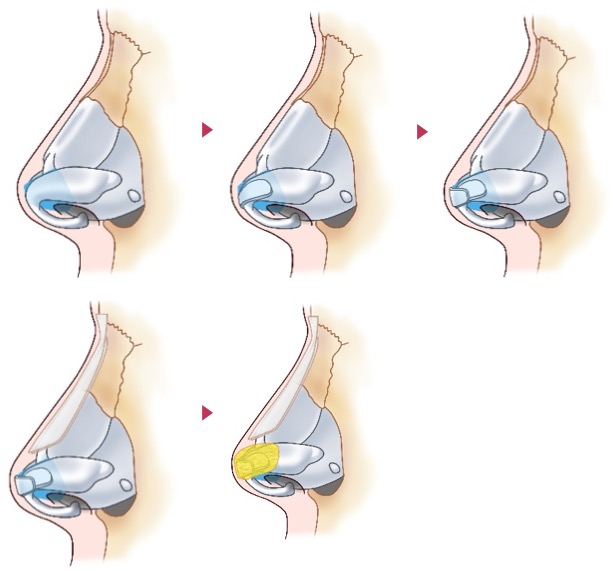
Reinforcement by grafting cartilage mainly on the lateral leg of the nasal ala cartilage.
This improves the nasal tip, which is too thin.
This is one way to correct pinch nose.
If desired, onlay graft or fat grafting can be used in combination.
Case 1
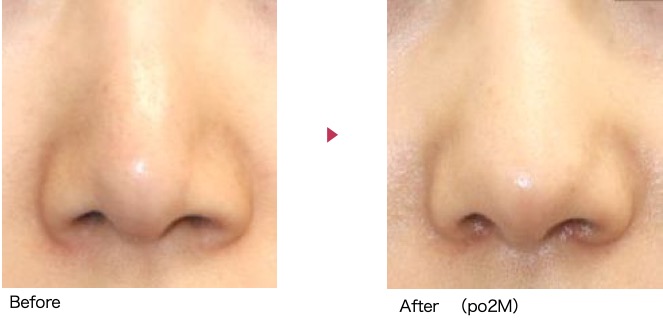
This patient underwent lateral crural graft and onlay graft to improve the nasal tip that was too small and the groove between the nasal alae was easily visible after bulbous tip correction.
Cost (tax included, anesthesia fee not included)
¥385,000
Risks/side effects (what could happen)
Swelling, internal bleeding, epistaxis, nasal congestion, discomfort, decreased perception of nasal tip and auricle, nasal tilt, left-right difference, hardening of nasal tip
Case 2
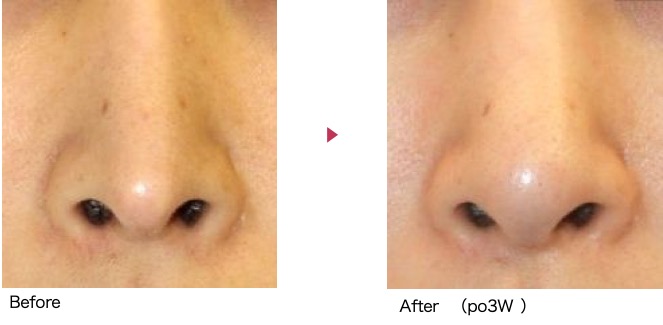
This patient’s nasal tip was too thin after bulbous tip correction and wanted to correct it naturally, so we performed a lateral crural graft, onlay graft and fat graft.
Cost (tax included, anesthesia fee not included)
¥385,000
Risks/side effects (what could happen)
Swelling, internal bleeding, epistaxis, nasal congestion, discomfort, decreased perception of nasal tip and auricle, nasal tilt, left-right difference, hardening of nasal tip
Revision of tip rhinoplasty
- Those who have undergone tip rhinoplasty at another clinic but do not like the shape.
- Those who have deformed nasal tip after tip rhinoplasty.
Those who have undergone tip rhinoplasty at another clinic but do not like the shape.
Those who have deformed nasal tip after tip rhinoplasty.
Surgery is often performed through an open approach, but also through a closed approach when possible.
Cartilage grafting from the auricle and subcutaneous fat grafting from the posterior auriclar surface are often used.
Deformity of the nasal tip can be corrected by shaving cartilage and grafting fat tissue.
Cartilage grafting and fat grafting are effective when the nasal tip is concave due to lack of tissue or excessive resection.
Cartilage grafting methods such as columellar-tip graft, onlay graft, arterial batten graft, and rim graft are often used.
Videos of tip rhinoplasty
References and articles on tip rhinoplasty
Suture algorithm for the broad or bulbous nasal tip.
Gruber RP, Friedman GD.Plast Reconstr Surg. 2002 Dec;110(7):1752-64; discussion 1765-8. doi: 10.1097/01.PRS.0000033873.20163.61.PMID: 12447060
Suture techniques for the nasal tip.
Gruber RP, Weintraub J, Pomerantz J.Aesthet Surg J. 2008 Jan-Feb;28(1):92-100. doi: 10.1016/j.asj.2007.10.004.PMID: 19083512
Frequently used grafts in rhinoplasty: nomenclature and analysis.
Gunter JP, Landecker A, Cochran CS.Plast Reconstr Surg. 2006 Jul;118(1):14e-29e. doi: 10.1097/01.prs.0000221222.15451.fc.PMID: 16816668
Nasal tip sutures part I: the evolution.
Behmand RA, Ghavami A, Guyuron B.Plast Reconstr Surg. 2003 Sep 15;112(4):1125-9; discussion 1146-9. doi: 10.1097/01.PRS.0000076503.78510.1C.PMID: 12973232
The alar contour graft: correction and prevention of alar rim deformities in rhinoplasty.
Rohrich RJ, Raniere J Jr, Ha RY.Plast Reconstr Surg. 2002 Jun;109(7):2495-505; discussion 2506-8. doi: 10.1097/00006534-200206000-00050.PMID: 12045582
Asian rhinoplasty.
Toriumi DM, Pero CD.Clin Plast Surg. 2010 Apr;37(2):335-52. doi: 10.1016/j.cps.2009.12.008.PMID: 20206750
Duration, downtime and aftercare of tip rhinoplasty
《After surgery》
Condition of the affected area
The entire nose is immobilized in a cast to reshape the nose and prevent swelling and internal bleeding.
It is usually immobilized for 5 days and is carefully removed during the procedure; do not remove it yourself.
If they are removed, the risk of prolonged swelling, nasal tip reshaping, or curvature goes up a bit.
If performed with an open approach, the retainer is suture-fixed to the nostrils.
Retainer should be used at home and other places as needed for 3-6 months after removal of fixation.
The nasal cavity is also sutured with blue thread.
Stitches are usually removed on the seventh day.
If performed via an open approach, there is scarring in the nasal cavity and columella.
The wound will be protected by a retainer or cast, so it will not be visible or touched from the outside.
If auricular cartilage or adipose tissue is used for tissue transplantation in tip rhinoplasty, cotton is suture-fixed to the ear to prevent auricular hematoma.
Please do not remove it by yourself.
The anesthesia may cause a sore throat.
Usually improves in a few days.
Post-operative checkup and aftercare
You will be examined by the doctor after surgery just before you go home.
And check the condition of the cast and retainer.
Antibiotics, painkillers (the pain is usually mild, but we prescribe them just in case), and gastric medicine will be prescribed for 4 days after surgery.
Lifestyle advice
Please be careful not to get your face wet until the cast is removed.
You may shower only from the neck down, but please refrain from bathing for a week.
The face should be wiped only.
Please refrain from washing your hair while the cast/ear immobilization cotton is attached.
If it is possible to protect the cast/ear cotton from getting wet, such as at a beauty salon, it is possible to wash hair.
The pain is not so severe and can be adequately controlled with ordinary oral analgesics.
Nosebleeds or nasal discharge with blood may occur.
When doing so, do not blow your nose or stuff tissues, but wipe gently.
When sleeping, please use cushions to elevate your upper body.
Sleeping on your stomach or side is prohibited as it causes stress on the nose.
After surgery, nasal congestion may occur due to swelling.
The original nasal septum cartilage is often not symmetrical and slightly tilted, so one side of the nose is more easily congested than the other.
Please refrain from drinking alcohol and smoking for about a week.
《Days 5 after surgery》【Please book an appointment for cast removal】
Condition of the affected area
This is the period when the post-operative swelling causes the nasal bridge to look thicker, the tip of the nose to look rounded, and other unnatural features.
With time, the swelling will surely decrease and improve.
There may be bruising around the nose.
The bruising will usually disappear in 1-2 weeks.
Temporary sensory loss may occur at the tip of the nose and other areas.
It will improve over time.
In the case of auricular cartilage grafting, there may be a dulling of sensation and numbness in the auricle.
There is tenderness for a while when touched.
It will improve over time.
Post-operative checkup and aftercare
There will be a medical checkup by a doctor.
Remove the cast/nostril retainer protecting the nose.
If performed with an open approach, stitches will be removed from the columella area.
If auricular cartilage is being harvested, remove the cotton for prevention of auricular hematoma.
Stitches are removed from your columella area.
Lifestyle advice
From the 5th day after surgery, you will be able to wash your hair and face as usual.
Post-operative rest is required.
Please refrain from strenuous exercise for 1-2 months.
For the open approach, wear the nasal retainer at bedtime and while at home.
Make-up can be applied to the wound from the next day (6th day after surgery).
If you have an open approach and are concerned about the redness of scars on the columella, please consult us for medical concealer.
Do not force the scab off.
Please wipe off nosebleeds and runny nose by pressing down lightly, and do not use cotton swabs.
Please refrain from blowing your nose for a month after the surgery.
《Days 7 after surgery》【Please book an appointment for stitches removal】
Condition of the affected area
After the fifth postoperative day, hair and face washing can be performed as usual.
Post-operative rest is required.
Please refrain from strenuous exercise for 1-2 months.
For the open approach, wear the nasal retainer at bedtime and while at home.
If you have an open approach and are concerned about the redness of scars on the columella, please consult us for medical concealer.
Do not force the scab off.
Please wipe off nosebleeds and runny nose by pressing down lightly, and do not use cotton swabs.
Please refrain from blowing your nose for a month after the surgery.
Post-operative checkup and aftercare
Stitches will be removed from your nasal cavity.
Stitches are removed from your auricular cartilage harvesting site.
Lifestyle advice
From the 7th day after surgery, you can bathe as usual.
Nose cleaning, sniffing, etc. should not be done for a month after the surgery.
Please refrain from touching your nose and sleeping on your stomach or side for 3 months after surgery, as it puts stress on the nose.
Sleep on your back, as lying on your side may cause pain in the ear wound.
For the open approach, wear the nasal retainer at bedtime and while at home.
《2 weeks after surgery》【It is recommended that you visit for a checkup】
Condition of the affected area
Swelling and internal bleeding will settle down considerably.
Redness of the scar is a normal process.
Please refrain from resting your ears down as this will cause pain.
Post-operative checkup and aftercare
You will be examined by a doctor.
There is no post-operative medical procedure.
Lifestyle advice
Nose sniffing, etc. should not be done for a month after the surgery.
Please refrain from touching your nose and sleeping on your stomach or side for 3 months after surgery, as it puts stress on the nose.
Sleep on your back, as lying on your side may cause pain in the ear wound.
For the open approach, wear the nasal retainer at bedtime and while at home.
《1 – 3 months after surgery》【It is recommended that you visit for a checkup】
Condition of the affected area
The wound will gradually heal completely, but there will be some swelling for a while.
Post-operative checkup and aftercare
You will be examined by a doctor.
There is no post-operative medical procedure.
Lifestyle advice
After a month post-operatively, you can blow your nose and clean your nose as usual.
Please refrain from touching your nose and sleeping on your stomach or side for 3 months after surgery, as it puts stress on the nose.
Sleep on your back, as lying on your side may cause pain in the ear wound.
For the open approach, wear the nasal retainer at bedtime and while at home.
《6 months after surgery》【It is recommended that you visit for a checkup】
Condition of the affected area
The wound has almost fully healed.
Your nose will gradually become softer and softer.
Nasal congestion will also improve.
Post-operative checkup and aftercare
You will be examined by a doctor.
There is no post-operative medical procedure.
Lifestyle advice
You can resume all of your daily activities, but just to be safe, protect the nose from bumping or crushing.
Nostril retainer attachment is no longer required.
FAQ
Answers to questions about tip rhinoplasty.
Click on each question to see the answer.
It settles down in about a week after surgery.
After surgery, you are usually immobilized in a cast for 5 days.
Make-up may be applied after cast removal.
Since cartilage grafts are autologous tissue grafts, your own tissues will blend and adhere to each other.
Once settled after surgery, the grafted cartilage will not move or shift.
The surgery is basically performed under intravenous anesthesia, so there is no pain or fear.
There is no significant postoperative pain.
If surgery under local anesthesia is desired, block anesthesia is used in combination with anesthesia to minimize the pain of administering anesthesia.
In the case of the close approach, the surgery is performed from inside the nose, leaving no scar on the skin of the nose.
In the case of the open approach, the scar is visible on the columella, but it is meticulously sutured to make it less noticeable.
While simple methods can cause regression, our bulbous tip correction, which involves the appropriate removal and grafting of fat and cartilage, does not cause regression once the shape has been stabilized.
Fees
| Tip Rhinoplasty | ¥385,000 |
All fees displayed include tax.
Normal post-operative symptoms, downtime, risks and complications
Underneath is a list of things that may occur.
In order to prevent any of these symptoms from occurring, we take safety measures and perform treatment with the utmost care.
We will always improve your symptoms.
Normal post-operative symptoms and downtime
Swelling
Swelling will go down in 7 – 10 days after surgery.
Things will completely settle down in about 3 months.
Bruising around the nose
There may be bruising around the nose.
It sometimes occurs, but it will disappear in a week or two.
Discomfort after surgery
Dull pain and discomfort may occur after surgery.
It often disappears within a few days.
Dull sensation at the tip of the nose
Postoperatively, there may be a dulling of sensation at the tip of the nose, but this is often temporary.
It will improve over time.
Nosebleed
Nasal bleeding may occur after surgery.
Do not put fingers or other objects in the nostrils.
Scar
If an open approach is used, a scar is left on the nasal column.
A scar will remain at the site of tissue harvesting (posterior surface of the auricle for auricular cartilage).
There is redness of the scar for a few months, followed by a light brown to white scar over time.
Over a period of 3-6 months, the scars become less noticeable.
Risks and complications
Post-operative nasal tilt, left-right difference
Perfect left-right symmetry is difficult to achieve because the human face originally has left-right differences.
If correctable by surgery, corrective surgery will be performed.
Nasal congestion
Nasal congestion occurs after surgery.
If nasal congestion does not improve after waiting 6 months, surgery may be required to improve it.
The nasal tip becomes stiff
The nasal tip will be stiffer than the original nose because of the tissue transplantation.
Infection
Although rare, there is a risk of infection with any surgery.
If infection occurs, it may be necessary to treat the infection with antibiotics or, in the case of pus accumulation, to perform a small incisional drainage to remove the source of infection.
Nasal tip is thick, not feeling the effects of surgery
Due to swelling and other factors, the nasal tip may not look as thin as expected after surgery.
Usually it gradually thins over the course of 3 to 6 months.
An injection procedure may be used to bring down the swelling as soon as possible.
Risks of cartilage tissue harvesting area
Auricular cartilage
A scar is left on the posterior surface of the auricle.
The sensation in the auricle may be dulled.
There is mild tenderness.
Since cartilage is extracted mainly from around the earlobe, it may be hard to wear earphones after surgery.
Dermal fat graft
Dermal adipose tissue from the posterior surface of the ear will be harvested.
A scar is left on the posterior surface of the auricle.
Sensory nerves are present, which can cause a decrease in perception.
Fascia
Harvesting the temporal fascia leaves a scar on the posterior surface of the auricle.
Sensory nerves are present, which can cause a decrease in perception.
Rhinoplasty list
Detailed information on each rhinoplasty procedure, including case photos, case progress photos, procedure duration, post-operative course, downtime, aftercare, risks and complications.
Supervising Doctor
Under the supervision of our plastic surgeons, we operate our website in accordance with medical advertising guidelines.
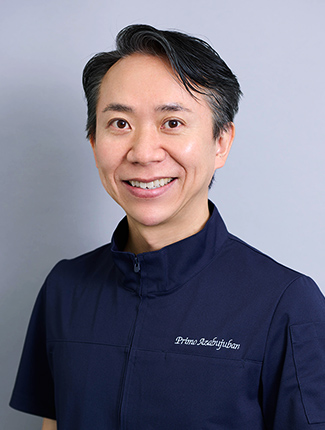
NORIHIRO OHBA M.D. Ph.D.
HEAD DIRECTOR/DIRECTOR
Qualifications and Academic Affiliations
Doctor of Medicine
Board Certified Plastic Surgeon, Japan Society of Plastic and Reconstructive Surgery
Board Certified Aesthetic Plastic Surgeon, Japanese Society of Aesthetic Plastic Surgery
Board Certified Aesthetic Plastic Surgeon, Japanese Society of Aesthetic Surgery
Anesthesiologist certified by the Ministry of Health, Labor and Welfare
Member of International Society of Aesthetic Plastic Surgery (ISAPS)
International Member of American Society of Plastic Surgeons (ASPS)
Member of Japan Society of Cranio-Maxillo Facial Surgery
Member of Japan Society of Laser Surgery and Medicine
Career
Graduated from Osaka City University Faculty of Medicine, 1996
Osaka City University Hospital Plastic and Reconstructive Surgery, 1996-1999
Osaka City University Graduate School of Medicine, 1999-2003
Osaka City University Hospital Plastic and Reconstructive Surgery, 2003-2005
Sano Memorial Hospital Plastic and Reconstructive Surgery, 2003-2005
Daito Central Hospital Plastic and Reconstructive Surgery, 2003-2005
Ritz Cosmetic Surgery Tokyo Clinic, 2005-2008
Primo Azabujuban Clinic, 2009~
Head Director, Primo Medical Corporation, 2011~
Head Director/Director, Primo Azabujuban Clinic, 2020~
