
The alar rim is elevated to refine and contour the nasal shape
Who is the alar rim resection suitable for?
- For those who want to improve their nostrils that tend to be hidden
- For those who wish to reduce the volume of the nasal alae
- For those who want to change the shape of their nostrils
- For those who want to make their nostrils more visible.
Alar-columellar relationship (ACR)
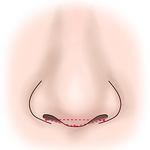
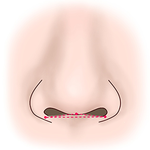
The alar-columellar relationship (ACR) is used as a standard for nasal esthetics.
ACR is defined by the positional relationship of a triangle, with the base formed by a line connecting the bilateral alar bases and the apex located at the columella. Ideally, this should form a downward-pointing isosceles triangle.
Conversely, a condition where the columellar base is positioned cephalad to the alar base is referred to as a “retracted columella,” which is considered aesthetically unfavorable.
Caudal septal extension graft is an effective procedure for significantly lengthening and lowering the columella.
ACR can also be improved by modifying the position and morphology of the alar rims.
There are several procedures available for refining the shape of the alar rims. We select the most appropriate method based on each patient’s unique nasal anatomy to achieve a natural-looking result.
For those with excessive alar rim volume and drooping nostrils, alar rim resection is the indicated procedure.
Conversely, for patients with thin alar rims and excessive nostril show, alar rim graft is the indicated procedure.
For those with large nostrils and significant alar flaring, alar base reduction is the indicated procedure.
For those with a drooping alar base, alar lift is the indicated procedure.
An explanation of the alar rim resection
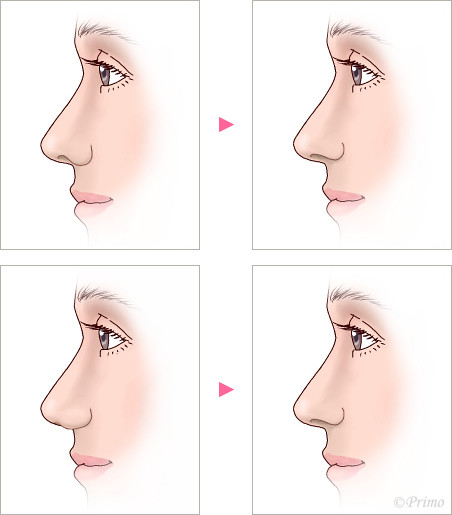
A condition in which the nasal alae are so large that they cover the nostrils and are difficult to see is called nasal ala ptosis.
The treatment is indicated for alar rim resection to raise the alar rim upward.
The alar rim refers to the outer edge of the nostril. Alar rim resection is a procedure that lifts the alar rim by excising a portion of the tissue and suturing it.
This surgery reduces the vertical width of the nasal alae and makes the entire nose appear slimmer.
Since the incision is made inside the nostril, the scar is not visible from the outside.
The wound heals well, making the scar itself highly inconspicuous.
Features of our alar rim resection
- The wound is only in the nasal cavity and is not noticeable.
- Skin excision is optimized for balance.
- Surgery is performed under intravenous anesthesia, without consciousness or pain.
Surgery method
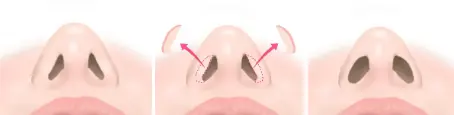
The procedure is performed under intravenous anesthesia.
In the alar rim resection, an appropriate amount of skin is removed from the nostril rim and carefully sutured with plastic surgical sutures to raise the nostril rim and make the nose appear cleaner and clearer.
References and articles on alar rim resection
Alar Base Reduction and Alar-Columellar Relationship.
Choi JY.Facial Plast Surg Clin North Am. 2018 Aug;26(3):367-375. doi: 10.1016/j.fsc.2018.03.010.PMID: 30005792 Review.
Alar Flare Preservation Using the Sandwich Technique as an Adjunct to Alar Base Reduction.
Abdelkader R, El-Noamany S, Taha A, Raafat SS.Plast Reconstr Surg Glob Open. 2021 May 6;9(5):e3569. doi: 10.1097/GOX.0000000000003569. eCollection 2021 May.PMID: 33977001
The Impact of Alar Flare Reduction Goes Beyond Just the Ala.
Gordon AR, Patel A, Schreiber JE, Layke JC, Tepper OM.Plast Reconstr Surg. 2023 Feb 27:e010311. doi: 10.1097/PRS.0000000000010311. Online ahead of print.PMID: 36827479
Dynamics in rhinoplasty.
Guyuron B.Plast Reconstr Surg. 2000 May;105(6):2257-9. doi: 10.1097/00006534-200005000-00057.PMID: 10839427
Duration, downtime and aftercare of alar rim resection
《After surgery》
Condition of the affected area
The nostril rim is sutured with black thread.
Stitches are usually removed on the seventh day.
Nasal plugs (cotton balls) are used to prevent bleeding.
Please remove it yourself after you return home on the same day.
There may be a difference in the shape of the nose from side to side after surgery due to swelling.
The nasal alae may appear slightly thicker.
The anesthesia may cause a sore throat.
Usually improves in a few days.
Post-operative checkup and aftercare
You will be examined by the doctor after surgery just before you go home.
Antibiotics, painkillers (the pain is usually mild, but we prescribe them just in case), and gastric medicine will be prescribed for 4 days after surgery.
Lifestyle advice
You can take a shower, wash your hair and face on the same day after surgery.
The pain is not so severe and can be adequately controlled with ordinary oral analgesics.
Make-up can be applied on the same day after surgery except for the affected area.
Nosebleeds or nasal discharge with blood may occur.
When doing so, do not blow your nose or stuff tissues, but wipe gently.
When sleeping, please use cushions to elevate your upper body.
Sleeping on your stomach or side is prohibited as it causes stress on the nose.
Please refrain from drinking alcohol and smoking for about a week.
《Days 7 after surgery》【Please book an appointment for stitches removal or checkup】
Condition of the affected area
The swelling will subside to some extent in 7 to 10 days after surgery.
There may be bruising around the nose.
The bruising will usually disappear in 1-2 weeks.
Temporary sensory loss may occur at the tip of the nose and other areas.
It will improve over time.
Post-operative checkup and aftercare
You will be examined by a doctor.
Stitches will be removed from your nasal cavity.
Lifestyle advice
Post-operative rest is required.
Please refrain from strenuous exercise for 1-2 months.
From the 7th day after surgery, you can bathe as usual.
Make-up can be applied to the wound from the next day (8th day after surgery).
Nose cleaning, sniffing, etc. should not be done for a month after the surgery.
Please refrain from touching your nose and sleeping on your stomach or side for 3 months after surgery, as it puts stress on the nose.
《2 weeks after surgery》【It is recommended that you visit for a checkup】
Condition of the affected area
Swelling and internal bleeding will settle down considerably.
Redness of the scar is a normal process.
Post-operative checkup and aftercare
You will be examined by a doctor.
There is no post-operative medical procedure.
Lifestyle advice
Nose sniffing, etc. should not be done for a month after the surgery.
Please refrain from touching your nose and sleeping on your stomach or side for 3 months after surgery, as it puts stress on the nose.
《1 – 3 months after surgery》【It is recommended that you visit for a checkup】
Condition of the affected area
The wound will gradually heal completely, but there will be some swelling for a while.
Post-operative checkup and aftercare
You will be examined by a doctor.
There is no post-operative medical procedure.
Lifestyle advice
After a month post-operatively, you can blow your nose and clean your nose as usual.
Please refrain from touching your nose and sleeping on your stomach or side for 3 months after surgery, as it puts stress on the nose.
《6 months after surgery》【It is recommended that you visit for a checkup】
Condition of the affected area
The wound has almost fully healed.
Your nose will gradually become softer and softer.
Nasal congestion will also improve.
Post-operative checkup and aftercare
You will be examined by a doctor.
There is no post-operative medical procedure.
Lifestyle advice
You can resume all of your daily activities, but just to be safe, protect the nose from bumping or crushing.
FAQ
Answers to questions about alar rim resection.
Click on each question to see the answer.
It settles down in about a week after surgery.
Since the scar is basically only in the nostrils, make-up can be applied immediately after the surgery.
Our nasal surgery is basically performed under intravenous anesthesia, so you will not feel any pain.
Surgery under local anesthesia is also available upon request.
Skin excision is basically performed inside the nostrils.
Careful plastic surgical sutures are performed so that no noticeable scars remain.
Fees
| Alar Rim Resection | ¥330,000 |
All fees displayed include tax.
Normal post-operative symptoms, downtime, risks and complications
Underneath is a list of things that may occur.
In order to prevent any of these symptoms from occurring, we take safety measures and perform treatment with the utmost care.
We will always improve your symptoms.
Normal post-operative symptoms and downtime
Swelling
Swelling will go down in 7 – 10 days after surgery.
Things will completely settle down in about 6 months.
Bruising around the nose
There may be bruising around the nose.
It sometimes occurs, but it will disappear in a week or two.
Discomfort after surgery
Dull pain and discomfort may occur after surgery.
It often disappears within a few days.
Nosebleed
Nasal bleeding may occur after surgery.
Do not put fingers or other objects in the nostrils.
Risks and complications
Left-right difference in nasal tip after surgery
A left-right difference in the shape of the nose may occur after surgery.
This may be due to the size and shape of the original nostrils, or slight differences in the amount and location of surgical manipulation.
We try to make the right and left sides as symmetrical as possible, but if there is a slight difference, we will correct it by revision surgery if necessary.
Nasal congestion
Nasal congestion occurs after surgery.
If nasal congestion does not improve, surgery may be required to improve it.
Nasal alae thicken
The nasal alae may be slightly thickened.
It seems that those with thicker original nasal ala skin are more likely to feel this way.
Infection
Although rare, there is a risk of infection with any surgery.
If infection occurs, it may be necessary to treat it with intravenous antibiotics, cleaning procedures, and in some cases removal of foreign bodies.
Reoperation is usually performed after 6-month interval when the condition has improved.
The effect of the alar rim resection seems insufficient.
Smaller excision of the skin at the nostril rim results in a smaller effect.
After the surgery, please wait for the swelling to subside, as it depends on the effect of the swelling.
If necessary, revision surgery will be performed to correct the problem.
Nostril rims raised too high.
If the amount of skin removed is too large, it may be raised too high.
In the unlikely event that you want to return after surgery, a skin-cartilage composite tissue transplantation may be necessary.
In such cases, surgery conform to alar rim graft is performed.
Rhinoplasty list
Detailed information on each rhinoplasty procedure, including case photos, case progress photos, procedure duration, post-operative course, downtime, aftercare, risks and complications.
Supervising Doctor
Under the supervision of our plastic surgeons, we operate our website in accordance with medical advertising guidelines.
NORIHIRO OHBA M.D. Ph.D.
HEAD DIRECTOR/DIRECTOR
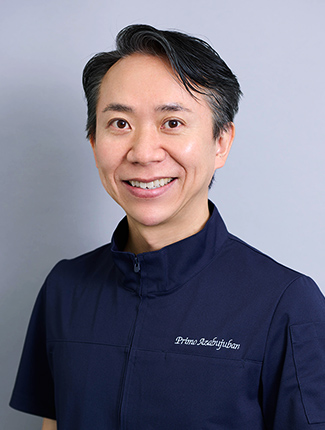
Qualifications and Academic Affiliations
Doctor of Medicine
Board Certified Plastic Surgeon, Japan Society of Plastic and Reconstructive Surgery
Board Certified Aesthetic Plastic Surgeon, Japanese Society of Aesthetic Plastic Surgery
Board Certified Aesthetic Plastic Surgeon, Japanese Society of Aesthetic Surgery
Anesthesiologist certified by the Ministry of Health, Labor and Welfare
Member of International Society of Aesthetic Plastic Surgery (ISAPS)
International Member of American Society of Plastic Surgeons (ASPS)
Member of Japan Society of Cranio-Maxillo Facial Surgery
Member of Japan Society of Laser Surgery and Medicine
Career
Graduated from Osaka City University Faculty of Medicine, 1996
Osaka City University Hospital Plastic and Reconstructive Surgery, 1996-1999
Osaka City University Graduate School of Medicine, 1999-2003
Osaka City University Hospital Plastic and Reconstructive Surgery, 2003-2005
Sano Memorial Hospital Plastic and Reconstructive Surgery, 2003-2005
Daito Central Hospital Plastic and Reconstructive Surgery, 2003-2005
Ritz Cosmetic Surgery Tokyo Clinic, 2005-2008
Primo Azabujuban Clinic, 2009~
Head Director, Primo Medical Corporation, 2011~
Head Director/Director, Primo Azabujuban Clinic, 2020~
