
For those with prominent nostrils that are lifted up
Who is the alar rim graft suitable for?
- For those with an upwardly notched alar rim
- For those who are concerned about excessive nostril show from the front
An explanation of alar rim graft
It is said that the nostrils should have a gently arched shape.
Surgery to lower the nostril rims is indicated for those whose nostril arches are steep and appear to be cut upward, or for those whose nostrils are easily visible from the front.
The alar rim is lowered by harvesting a composite skin-cartilage graft from the ear and transplanting it through an intranasal incision.
Since the incision is made inside the nose, the scars are not visible.
The incision on the ear for harvesting the composite graft also heals cleanly and remains inconspicuous.
Conversely, if the nostril rims are lowered and the nostrils are covered and difficult to see, surgery to raise the nostril rims is indicated.
Features of our alar rim graft
- It reduces the appearance of the nostrils.
- The skin-cartilage composite tissue harvesting site is basically from the scapha of the auricle, with minimal scarring.
- Surgery is performed under general anesthesia to ensure a safe airway.
Surgery method
The procedure is performed under general anesthesia.
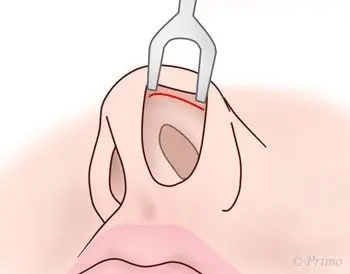
The hairless skin inside the nostril is advanced and unfolded, and the resulting skin defect is repaired by transplanting a composite skin-cartilage graft harvested from the ear.
The symmetry is carefully balanced, the position is adjusted and fixed, and finally, the incisions are sutured.
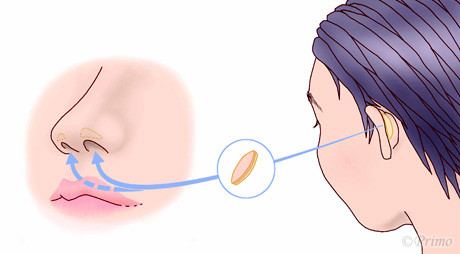
This makes the nostrils less visible.
Scars are less noticeable because they are inside the nasal cavity.
A retainer is secured to prevent postoperative nostril deformity, concluding the procedure.
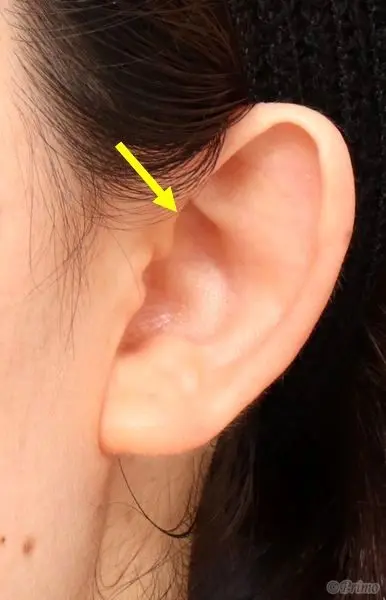
The skin-cartilage composite tissue of the auricle is usually taken from the scapha (yellow arrow), and the area from which the tissue was taken is repaired with skin from the posterior surface of the auricle, so the auricle heals very nicely without deformity.
Revision of alar rim graft
- For those who have undergone alar rim graft at another clinic but would like to lower it a little more.
- For those who have undergone alar rim graft at another clinic but want to adjust it because it has fallen too low.
- For those who are concerned about the shape and thickness of the nostrils after alar rim graft.
If you have undergone alar rim graft at another clinic and are dissatisfied with the shape, we can suggest a revision procedure.
If the morphology of the nostril rim is to be lowered further, we will consider lowering it again with an skin-cartilage composite tissue graft, or using a caudal septal extension graft to lower the nostril rim.
Conversely, if the nostril rim is too low, the nostrils can be enlarged by alar rim resection.
Subtle adjustments to the shape and thickness of the nostrils can be made with individual tissue removal or grafting.
References and articles on alar rim graft
Surgical Correction of Retracted Nostril Rim with Auricular Composite Grafts and Anchoring Suspension.
Hirohi T, Yoshimura K.Aesthetic Plast Surg. 2004 Jan;28(1):58. doi: 10.1007/s00266-004-2812-4.PMID: 15383896
Dynamics of the alar rim graft.
Guyuron B, Bigdeli Y, Sajjadian A.Plast Reconstr Surg. 2015 Apr;135(4):981-986. doi: 10.1097/PRS.0000000000001128.PMID: 25502861
Grafting the alar rim: application as anatomical graft.
Gruber RP, Fox P, Peled A, Belek KA.Plast Reconstr Surg. 2014 Dec;134(6):880e-887e. doi: 10.1097/PRS.0000000000000764.PMID: 25415110
Alar rim deformities.
Guyuron B.Plast Reconstr Surg. 2001 Mar;107(3):856-63. doi: 10.1097/00006534-200103000-00032.PMID: 11304615
Correction of the Nasal Ala.
Locketz GD, Franco A, Miller PJ.Facial Plast Surg. 2022 Feb;38(1):70-73. doi: 10.1055/a-1724-3656. Epub 2021 Jan 14.PMID: 34921357
Duration, downtime and aftercare of alar rim graft
《After surgery》
Condition of the affected area
The entire nose is usually immobilized in a cast for 7 days to reshape the nose and prevent swelling and internal bleeding.
Do not remove until instructed to do so.
Removal increases the risk of nasal tip reshaping and bending due to prolonged swelling and tissue necrosis.
Retainer is suture-fixed to the nostril.
Retainer should be used at home and other places as needed for 3-6 months after removal of fixation.
The nasal cavity is also sutured with blue thread.
Stitches are usually removed in 2 weeks.
Scars are left on the anterior surface of the auricle.
A cotton is sutured and fixed to the ear to prevent auricular hematoma.
Please do not remove it by yourself.
The anesthesia may cause a sore throat.
Usually improves in a few days.
Post-operative checkup and aftercare
You will be examined by the doctor after surgery just before you go home.
And check the condition of the cast.
Antibiotics, painkillers (the pain is usually mild, but we prescribe them just in case), and gastric medicine will be prescribed for 4 days after surgery.
Lifestyle advice
Please be careful not to get your face wet until the cast is removed.
You can shower only from the neck down, or from the chest down if a drain is attached.
Please refrain from bathing for a week.
The face should be wiped only.
Please refrain from washing your hair while the cast/ear immobilization cotton is attached.
If it is possible to protect the cast/ear cotton from getting wet, such as at a beauty salon, it is possible to wash hair.
The pain is not so severe and can be adequately controlled with ordinary oral analgesics.
Nosebleeds or nasal discharge with blood may occur.
When doing so, do not blow your nose or stuff tissues, but wipe gently.
When sleeping, please use cushions to elevate your upper body.
Sleeping on your stomach or side is prohibited as it causes stress on the nose.
Please refrain from drinking alcohol and smoking for about a week.
《Days 7 after surgery》【Please book an appointment for cast removal and stitches removal】
Condition of the affected area
This is the time when the nasal tip feels rounded and unnatural due to post-operative swelling.
With time, the swelling will surely decrease and improve.
There may be bruising around the nose.
The bruising will usually disappear in 1-2 weeks.
Temporary sensory loss may occur at the tip of the nose and other areas.
It will improve over time.
In the case of auricular cartilage grafting, there may be a dulling of sensation and numbness in the auricle.
It will improve over time.
Postoperatively, there may be a difference between the left and right sides of the nose.
The risk is higher if the grafted tissue does not survive well.
The nostril rim will be slightly thicker and stiffer than the original nose because of the cartilage graft.
Post-operative checkup and aftercare
You will be examined by a doctor.
Remove the cast/nostril retainer protecting the nose.
If auricular cartilage is being harvested, remove the cotton for prevention of auricular hematoma.
Stitches will also be removed from the auricular wound.
Lifestyle advice
Post-operative rest is required.
Please refrain from strenuous exercise for 1-2 months.
From the 7th day after surgery, you can wash your hair and face, and bathe as usual.
Make-up can be applied from the next day (8th day after surgery) except for the affected area.
Do not force the scab off.
Please wipe off nosebleeds and runny nose by pressing down lightly, and do not use cotton swabs.
Nose cleaning, sniffing, etc. should not be done for a month after the surgery.
Please refrain from touching your nose and sleeping on your stomach or side for 3 months after surgery, as it puts stress on the nose.
Sleep on your back, as lying on your side may cause pain in the ear wound.
Wear the nasal retainer at bedtime and while at home.
《2 weeks after surgery》【Please book an appointment for stitches removal or checkup】
Condition of the affected area
Swelling and internal bleeding will settle down considerably.
Redness of the scar is a normal process.
Please refrain from resting your ears down as this will cause pain.
Post-operative checkup and aftercare
You will be examined by a doctor.
Stitches will be removed from your nasal cavity.
Lifestyle advice
Make-up can be applied to the wound from the next day (15th day after surgery).
Nose sniffing, etc. should not be done for a month after the surgery.
Please refrain from touching your nose and sleeping on your stomach or side for 3 months after surgery, as it puts stress on the nose.
Sleep on your back, as lying on your side may cause pain in the ear wound.
Wear the nasal retainer at bedtime and while at home.
《1 – 3 months after surgery》【It is recommended that you visit for a checkup】
Condition of the affected area
The wound will gradually heal completely, but there will be some swelling for a while.
Post-operative checkup and aftercare
You will be examined by a doctor.
There is no post-operative medical procedure.
Lifestyle advice
After a month post-operatively, you can blow your nose and clean your nose as usual.
Please refrain from touching your nose and sleeping on your stomach or side for 3 months after surgery, as it puts stress on the nose.
Sleep on your back, as lying on your side may cause pain in the ear wound.
Wear the nasal retainer at bedtime and while at home.
《6 months after surgery》【It is recommended that you visit for a checkup】
Condition of the affected area
The wound has almost fully healed.
Your nose will gradually become softer and softer.
Nasal congestion will also improve.
Post-operative checkup and aftercare
You will be examined by a doctor.
There is no post-operative medical procedure.
Lifestyle advice
You can resume all of your daily activities, but just to be safe, protect the nose from bumping or crushing.
Retainer does not need to be attached.
FAQ
Answers to questions about alar rim graft.
Click on each question to see the answer.
It settles down in about a week after surgery.
After nasal apex surgery, you are usually immobilized in a cast for 3 to 5 days.
Make-up may be applied after cast removal.
Rest in the early post-operative period is very important for tissue transplantation.
Cast immobilization is used to maintain rest.
Since cartilage grafts are autologous tissue grafts, your own tissues will blend and adhere to each other.
Once settled after surgery, the grafted cartilage will not move or shift.
Our nasal surgery is basically performed under intravenous anesthesia, so you will not feel any pain.
Since the grafting is done inside the nose, the scar is not easily visible, but the nasal alae become slightly thicker and firmer.
The ear wound from which the skin cartilage is extracted will be made less noticeable.
Fees
| Alar Rim Graft | ¥550,000 |
All fees displayed include tax.
Normal post-operative symptoms, downtime, risks and complications
Underneath is a list of things that may occur.
In order to prevent any of these symptoms from occurring, we take safety measures and perform treatment with the utmost care.
We will always improve your symptoms.
Normal post-operative symptoms and downtime
Retainer attached
Removal of retainer fixation is usually performed on day 7.
Retainer is recommended to be worn as much as possible after removal of fixation (throughout the day, for a period of 6 months).
Swelling
Swelling will go down in 7 – 10 days after surgery.
Things will completely settle down in about 6 months.
Bruising around the nose
There may be bruising around the nose.
It sometimes occurs, but it will disappear in a week or two.
Discomfort after surgery
Dull pain and discomfort may occur after surgery.
It often disappears within a few days.
Dull sensation at the tip of the nose
Postoperatively, there may be a dulling of sensation at the tip of the nose, but this is often temporary.
It will improve over time.
Risks and complications
Left-right difference in nasal tip after surgery
A left-right difference in the shape of the nose may occur after surgery.
The risk increases with poor tissue transplantation survival.
If correctable by surgery, corrective surgery will be performed.
Nasal congestion
Nasal congestion occurs after surgery.
If nasal congestion does not improve after waiting 6 months, surgery may be required to improve it.
Hardening and thickening of the nasal tip and nostril area
The grafted area will be slightly stiffer and thicker than the original nose because of the skin cartilage graft.
Initially, the swelling makes it feel extraordinarily so, but after six months to a year, it settles down considerably.
Infection
Although rare, there is a risk of infection with any surgery.
If infection occurs, it may be necessary to treat it with intravenous antibiotics, cleaning procedures, and in some cases removal of foreign bodies.
Reoperation is usually performed after 6-month interval when the condition has improved.
In such cases, revision surgery is performed using the skin cartilage of the auricle.
Necrosis
The grafted tissue may become necrotic if it becomes infected or damaged due to failure to rest.
In such cases, a left-right difference in nostrils or snoring may occur.
It may also result in inadequate effectiveness of the surgery.
If correctable by surgery, corrective surgery will be performed.
Risks of cartilage tissue harvesting area
Auricular cartilage
A scar is left on the anterior surface of the auricle.
Tissue will be harvested from areas that are difficult to see.
The sensation in the auricle may be dulled.
There is mild tenderness.
The auricle may feel just a little bit smaller.
Rhinoplasty list
Detailed information on each rhinoplasty procedure, including case photos, case progress photos, procedure duration, post-operative course, downtime, aftercare, risks and complications.
Supervising Doctor
Under the supervision of our plastic surgeons, we operate our website in accordance with medical advertising guidelines.
NORIHIRO OHBA M.D. Ph.D.
HEAD DIRECTOR/DIRECTOR
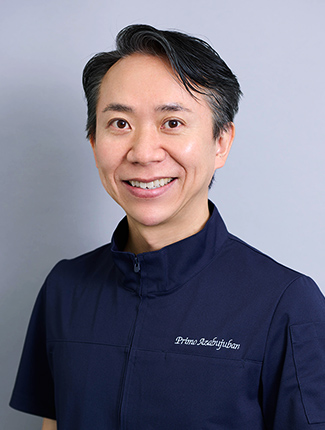
Qualifications and Academic Affiliations
Doctor of Medicine
Board Certified Plastic Surgeon, Japan Society of Plastic and Reconstructive Surgery
Board Certified Aesthetic Plastic Surgeon, Japanese Society of Aesthetic Plastic Surgery
Board Certified Aesthetic Plastic Surgeon, Japanese Society of Aesthetic Surgery
Anesthesiologist certified by the Ministry of Health, Labor and Welfare
Member of International Society of Aesthetic Plastic Surgery (ISAPS)
International Member of American Society of Plastic Surgeons (ASPS)
Member of Japan Society of Cranio-Maxillo Facial Surgery
Member of Japan Society of Laser Surgery and Medicine
Career
Graduated from Osaka City University Faculty of Medicine, 1996
Osaka City University Hospital Plastic and Reconstructive Surgery, 1996-1999
Osaka City University Graduate School of Medicine, 1999-2003
Osaka City University Hospital Plastic and Reconstructive Surgery, 2003-2005
Sano Memorial Hospital Plastic and Reconstructive Surgery, 2003-2005
Daito Central Hospital Plastic and Reconstructive Surgery, 2003-2005
Ritz Cosmetic Surgery Tokyo Clinic, 2005-2008
Primo Azabujuban Clinic, 2009~
Head Director, Primo Medical Corporation, 2011~
Head Director/Director, Primo Azabujuban Clinic, 2020~
